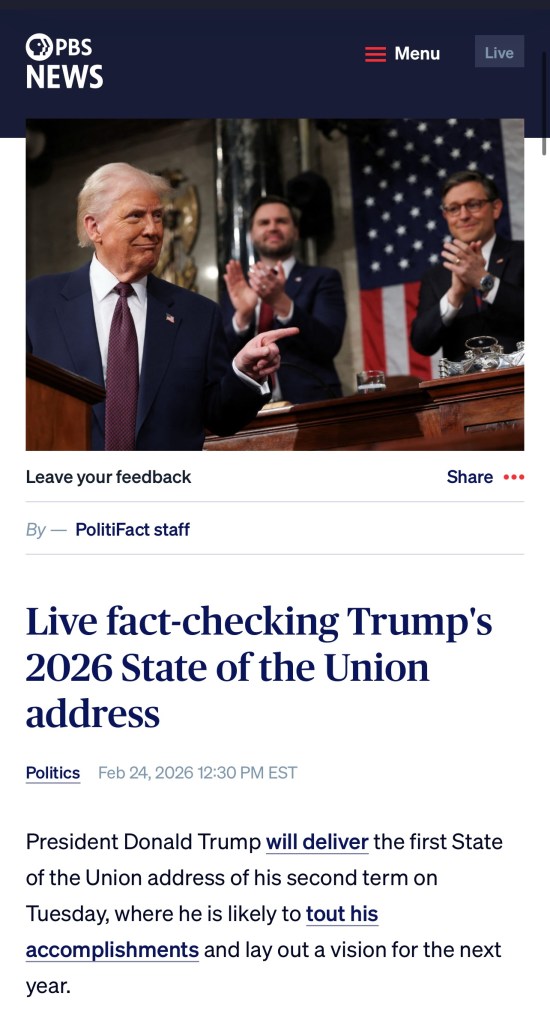
There’s a particular kind of irony that doesn’t make you laugh so much as exhale — that quick, knowing breath that says, Of course this is where we are now. That was my reaction reading PBS’s live fact‑checking of the 2026 State of the Union address.
The article itself is straightforward enough: a running, real‑time verification of the President’s claims as he delivers them. But the very existence of such a feature — and its necessity — says more about the state of the country than any line in the speech.
To be fair, fact‑checking the State of the Union isn’t new. Newsrooms have been doing it in some form since the early 2000s. But the feeling of it has changed. What used to be a next‑day analysis has become a parallel broadcast. What used to be a journalistic courtesy now feels like a civic safeguard. And that shift — from optional to essential — lands differently depending on who is speaking.
PBS didn’t treat their fact‑check as a novelty. It was presented as a public service, almost a requirement. Before the President even began, they reminded readers that only 19% of his campaign promises had been fulfilled, according to PolitiFact — a quiet signal that the evening would require context, correction, and careful listening. That’s the part that stays with me. Not the claims themselves, but the infrastructure now required to accompany them.
The State of the Union used to be a report to the nation. Now it arrives with a chaperone.
It’s tempting to laugh at the absurdity of it — the way the fact‑checkers sit just offstage, ready to annotate the moment. But beneath the humor is something heavier: a grief for what public discourse once aspired to be. The need for real‑time verification is not a sign of a healthy political culture. It’s a sign of erosion — of trust, of shared reality, of the assumption that words spoken from the highest office should at least gesture toward truth.
And yet, there is something quietly hopeful in the work PBS and others are doing. Their presence is steady, unflustered, almost pastoral in its own way. They don’t interrupt. They don’t editorialize. They simply place the facts beside the claims and let the contrast speak for itself. In a time when spectacle often overwhelms substance, that restraint is its own form of civic care.
A State of the Union that requires real‑time verification is not a sign of national strength. It’s a sign of how far we’ve drifted from the expectation that truth belongs at the center of public life. Until that expectation returns, the fact‑checkers will remain in the room — not as critics, but as guardians.
Link to PBS article:
https://www.pbs.org/newshour/politics/live-fact-checking-trumps-2026-state-of-the-union-address
