
When Power Rejects Accountability: What the Kent Resignation Tells Us About Trump’s Leadership Culture

The resignation of National Counterterrorism Center Director Joe Kent should have opened a rare window for introspection inside the administration. Kent did not leave in silence. He left with a warning: that the march toward war with Iran lacked an imminent threat, lacked strategic coherence, and was propelled by pressures the public has not been allowed to see. These are the kinds of concerns a healthy administration would confront head-on.

Instead, the president dismissed Kent as “weak on security” and “not up to the job.” The critique was not answered; the critic was diminished. And in that exchange — documented plainly in the AP report — we see a leadership culture that treats dissent not as a resource but as a threat.
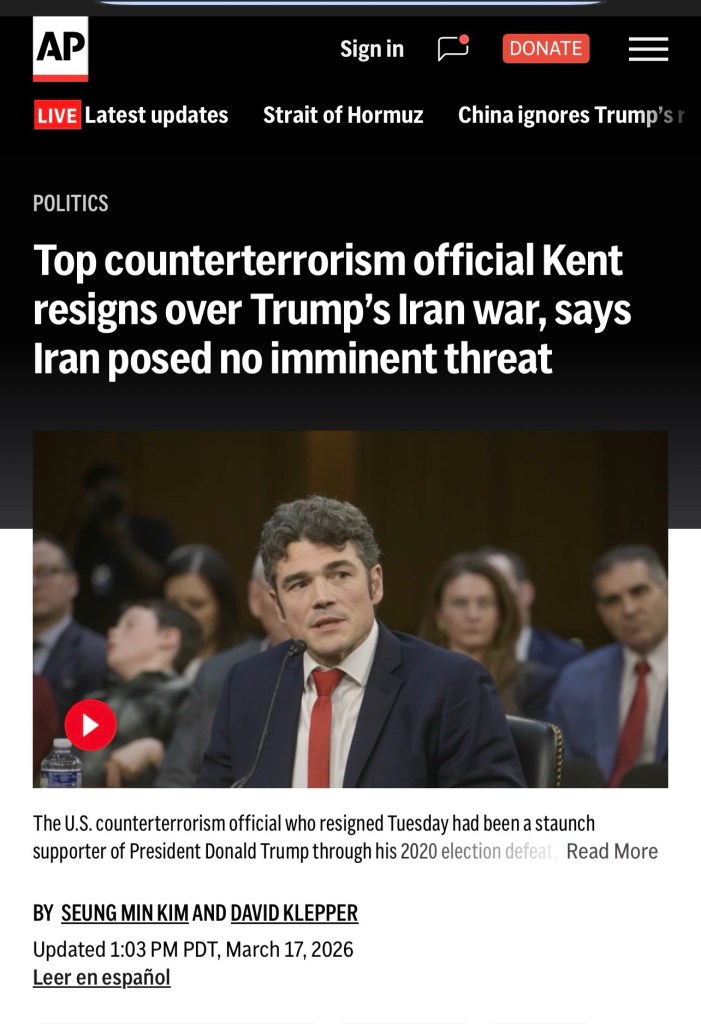
This is not an isolated moment. It is a governing pattern. Appointees are celebrated when they affirm the president’s position and maligned when they depart from it. The shift is instantaneous: competence becomes incompetence, loyalty becomes betrayal, and expertise becomes weakness. The individual changes; the script does not.

What makes the Kent episode especially revealing is the gravity of the issue at hand. War demands clarity, accountability, and the courage to face uncomfortable truths. Kent attempted to raise those truths. The administration responded with personal attack. The public is left with no clearer understanding of the policy — only a clearer understanding of the leadership style.

A government that cannot tolerate internal critique becomes brittle. It loses the ability to self-correct. It drifts toward decisions shaped not by deliberation but by deference. And when the stakes are measured in lives, that brittleness becomes dangerous.

The AP report does not editorialize. It simply records what was said. But the implications are unavoidable. If every departing official is recast as weak or disloyal, the public must ask whether the problem is always the appointee — or whether the deeper issue is a leadership culture that rejects accountability itself.

In moments of national consequence, the country needs leaders who can absorb critique without collapsing into grievance. Leaders who can distinguish disagreement from disloyalty. Leaders who understand that strength is not measured by the volume of one’s dismissals but by the capacity to engage the truth, even when it is inconvenient.

Joe Kent’s resignation offered an opportunity for that kind of leadership. The response made clear that opportunity was refused.
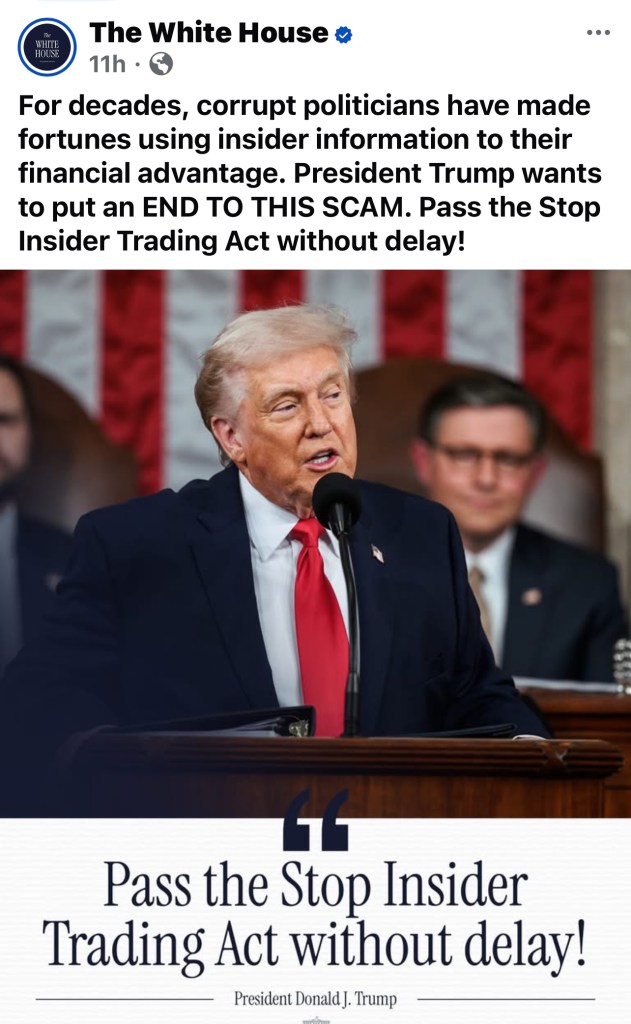
When Outrage Isn’t Reform: The Long Shadow of Insider Trading in Government

Every few years, Washington rediscovers its moral outrage over insider trading. The language is always sharp, the promises sweeping: end the scam, stop the corruption, protect the American people. The latest call from the White House to ban stock trading by politicians fits neatly into that familiar pattern. It is a good promise. It is also a reminder of how often this promise has been made before.

Insider trading is one of the few issues that unites Americans across political lines. People instinctively understand the unfairness of it. When elected officials or senior staff can buy or sell stocks while holding information the public does not yet have, the playing field tilts. Even if no law is technically broken, the trust that holds democratic institutions together begins to fray.

That is why the renewed rhetoric caught my attention. Not because the goal is wrong, but because the history is long. At the beginning of the Trump administration, investigative reporters uncovered a cluster of unusually well‑timed stock sales by senior officials. The pattern was hard to miss: trades made days before major tariff announcements that sent markets tumbling. Nothing was proven illegal, but ethics experts said then what they say now—when people with privileged information move their money just before the public feels the impact, trust erodes. The appearance of self‑dealing is enough to damage institutions.

This is not a partisan problem. It is a structural one. The same concerns have surfaced under Democratic administrations, Republican administrations, and Congresses of every composition. The temptation is built into the system: the people who write the rules are allowed to trade in the very markets their decisions influence. No amount of messaging can make that tension disappear.

The deeper issue is not who sits in the Oval Office or which party controls the House. It is the quiet, corrosive effect of a system that permits lawmakers and high‑ranking officials to trade individual stocks at all. When public servants can personally benefit—or avoid losses—based on the timing of policy decisions, the conflict is not incidental. It is inherent.

Ending insider trading in government is a worthy goal. But it requires more than slogans and more than outrage. It requires rules that apply to everyone, in every administration, without exception. It requires transparency strong enough to withstand political cycles and public pressure. And it requires the humility to admit that trust, once lost, is not easily restored.

The public is not asking for perfection. It is asking for fairness. It is asking for a government that does not play by a different set of rules. And it is asking for leaders who understand that integrity is not a talking point—it is a practice.

The promise to end insider trading will matter only when it becomes more than a promise. Until then, the cycle will continue: outrage, investigation, denial, and another round of well‑timed trades that leave the public wondering whose interests are truly being served.