
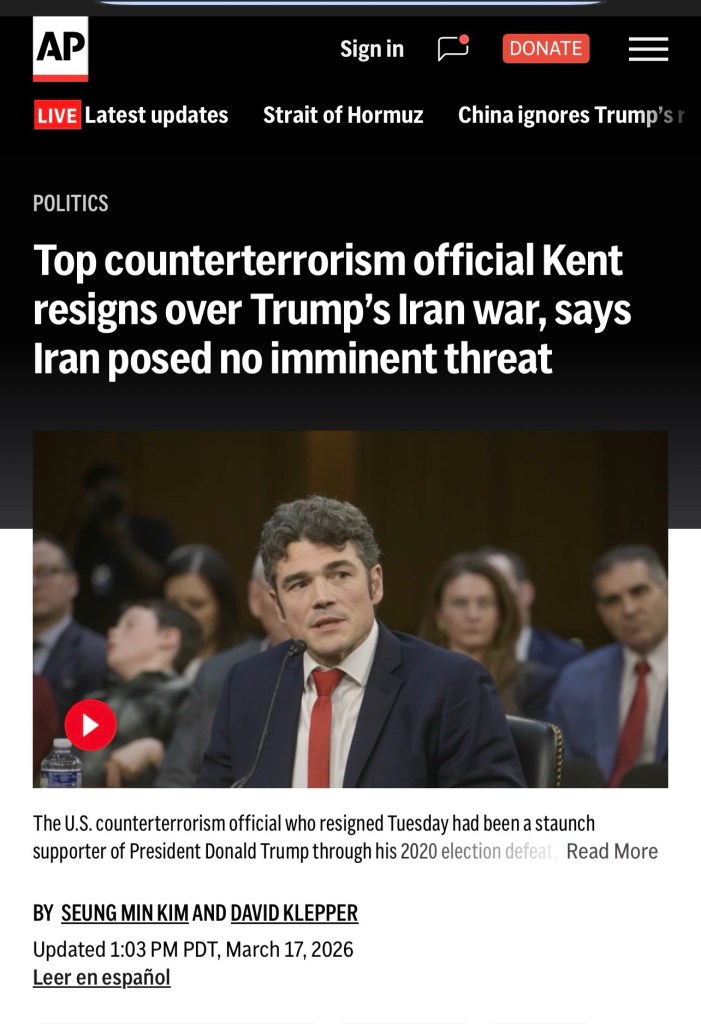
The resignation of National Counterterrorism Center Director Joe Kent should have opened a rare window for introspection inside the administration. Kent did not leave in silence. He left with a warning: that the march toward war with Iran lacked an imminent threat, lacked strategic coherence, and was propelled by pressures the public has not been allowed to see. These are the kinds of concerns a healthy administration would confront head-on.
Instead, the president dismissed Kent as “weak on security” and “not up to the job.” The critique was not answered; the critic was diminished. And in that exchange — documented plainly in the AP report — we see a leadership culture that treats dissent not as a resource but as a threat.
This is not an isolated moment. It is a governing pattern. Appointees are celebrated when they affirm the president’s position and maligned when they depart from it. The shift is instantaneous: competence becomes incompetence, loyalty becomes betrayal, and expertise becomes weakness. The individual changes; the script does not.
What makes the Kent episode especially revealing is the gravity of the issue at hand. War demands clarity, accountability, and the courage to face uncomfortable truths. Kent attempted to raise those truths. The administration responded with personal attack. The public is left with no clearer understanding of the policy — only a clearer understanding of the leadership style.
A government that cannot tolerate internal critique becomes brittle. It loses the ability to self-correct. It drifts toward decisions shaped not by deliberation but by deference. And when the stakes are measured in lives, that brittleness becomes dangerous.
The AP report does not editorialize. It simply records what was said. But the implications are unavoidable. If every departing official is recast as weak or disloyal, the public must ask whether the problem is always the appointee — or whether the deeper issue is a leadership culture that rejects accountability itself.
In moments of national consequence, the country needs leaders who can absorb critique without collapsing into grievance. Leaders who can distinguish disagreement from disloyalty. Leaders who understand that strength is not measured by the volume of one’s dismissals but by the capacity to engage the truth, even when it is inconvenient.
Joe Kent’s resignation offered an opportunity for that kind of leadership. The response made clear that opportunity was refused.
