The Editorial Room is born in the space between headlines and understanding — a quiet corner of the digital world dedicated to clear, grounded analysis of the news and public life.
And when children die in their classrooms, the world does not need spin, or deflection, or leaders reaching for the nearest convenient enemy. The world needs truth. The world needs grief. The world needs accountability that does not wait for political permission.
A prophetic voice begins here:
No nation is righteous enough to excuse the killing of children.
No military is precise enough to call this “collateral.”
No leader is credible if they answer a mass grave with a shrug or a conspiracy.
The facts are still being investigated.
But the scale of harm is not in question.
And when the smallest coffins are lowered into the ground, the burden of truth rises — not falls.
So this must be said plainly:
• A school is not a battlefield.
• A child is not an acceptable loss.
• And any government involved — directly or indirectly — owes the world not a justification, but a confession.
Prophetic speech does not wait for the powerful to feel ready.
It speaks because the dead cannot.
—
Update:
The most authoritative, up‑to‑date figure comes from Al Jazeera’s live casualty tracker, which reports:
“168 children were killed in the Minab elementary school strike.”
This aligns with the higher end of earlier reports (115–168 total children), but the 168 figure is the latest confirmed and comes from Iran’s deputy health minister speaking directly to Al Jazeera.
There’s a particular kind of irony that doesn’t make you laugh so much as exhale — that quick, knowing breath that says, Of course this is where we are now. That was my reaction reading PBS’s live fact‑checking of the 2026 State of the Union address.
The article itself is straightforward enough: a running, real‑time verification of the President’s claims as he delivers them. But the very existence of such a feature — and its necessity — says more about the state of the country than any line in the speech.
To be fair, fact‑checking the State of the Union isn’t new. Newsrooms have been doing it in some form since the early 2000s. But the feeling of it has changed. What used to be a next‑day analysis has become a parallel broadcast. What used to be a journalistic courtesy now feels like a civic safeguard. And that shift — from optional to essential — lands differently depending on who is speaking.
PBS didn’t treat their fact‑check as a novelty. It was presented as a public service, almost a requirement. Before the President even began, they reminded readers that only 19% of his campaign promises had been fulfilled, according to PolitiFact — a quiet signal that the evening would require context, correction, and careful listening. That’s the part that stays with me. Not the claims themselves, but the infrastructure now required to accompany them.
The State of the Union used to be a report to the nation. Now it arrives with a chaperone.
It’s tempting to laugh at the absurdity of it — the way the fact‑checkers sit just offstage, ready to annotate the moment. But beneath the humor is something heavier: a grief for what public discourse once aspired to be. The need for real‑time verification is not a sign of a healthy political culture. It’s a sign of erosion — of trust, of shared reality, of the assumption that words spoken from the highest office should at least gesture toward truth.
And yet, there is something quietly hopeful in the work PBS and others are doing. Their presence is steady, unflustered, almost pastoral in its own way. They don’t interrupt. They don’t editorialize. They simply place the facts beside the claims and let the contrast speak for itself. In a time when spectacle often overwhelms substance, that restraint is its own form of civic care.
A State of the Union that requires real‑time verification is not a sign of national strength. It’s a sign of how far we’ve drifted from the expectation that truth belongs at the center of public life. Until that expectation returns, the fact‑checkers will remain in the room — not as critics, but as guardians.
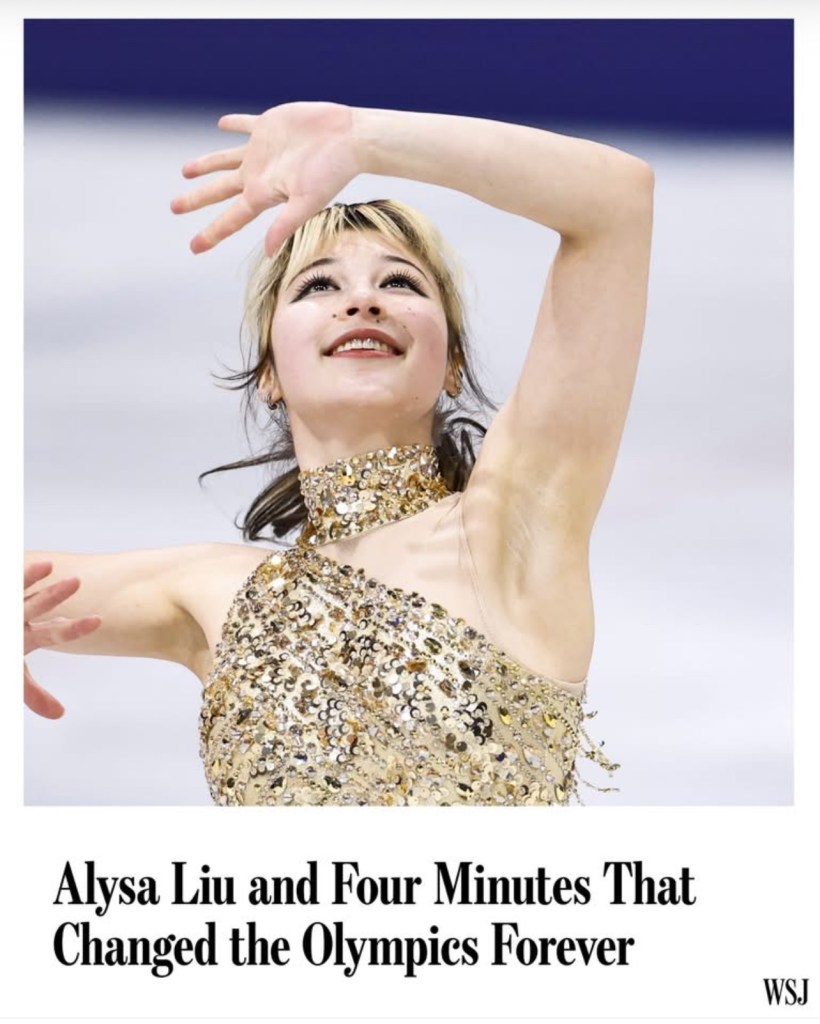
Some Olympic moments impress us; others change the emotional weather. Alysa Liu’s free skate in Milan was the latter. Writing in The Wall Street Journal, columnist Jason Gay described her performance as something more than a gold‑medal routine — a kind of mood shift, a skate that felt liberated, exuberant, and defiantly joyful in a sport often shadowed by pressure and judgment.
That framing stayed with me. Because what Liu offered on the ice wasn’t simply athletic excellence; it was a glimpse of what freedom looks like when it’s allowed to breathe. Watching her, I found myself wondering what it would mean for a whole nation — even a whole world — to experience that kind of shift. To be released, even briefly, from the stress we endure or the stress we impose on ourselves. To remember that joy is not frivolous; it is clarifying.
There is another layer to Liu’s story that deserves attention. She is the daughter of an immigrant. Her gold medal is one more quiet testament to what America has long claimed about itself: that when this country welcomes people from every corner of the world, it receives gifts it could never have produced alone. Her victory is not an argument; it is evidence — evidence of what becomes possible when a nation’s posture is open rather than fearful.
And yet, that posture is contested today. The national mood feels tight, suspicious, and often punitive. It’s no surprise that satire has become a coping mechanism. One recent joke imagined President Donald Trump inviting Alysa Liu to the White House “but only her white half.” It’s absurd, of course — that’s the point. Satire exaggerates to expose what we fear might be true. It reveals the fractures we would rather not name.
But satire is not the final word. Joy is. Liu’s skate was a reminder that joy can still break through the heaviness of our public life. It can still rebuke cynicism without a single political statement. It can still show us who we might become if we allowed ourselves — and one another — to breathe again.
Perhaps that is the real gift of her gold medal: not the victory itself, but the possibility of a different national mood. A mood marked by welcome rather than suspicion. By delight rather than dread. By the kind of freedom that lets a young skater laugh her way into Olympic history.
If only we could let that mood shift take root beyond the rink.
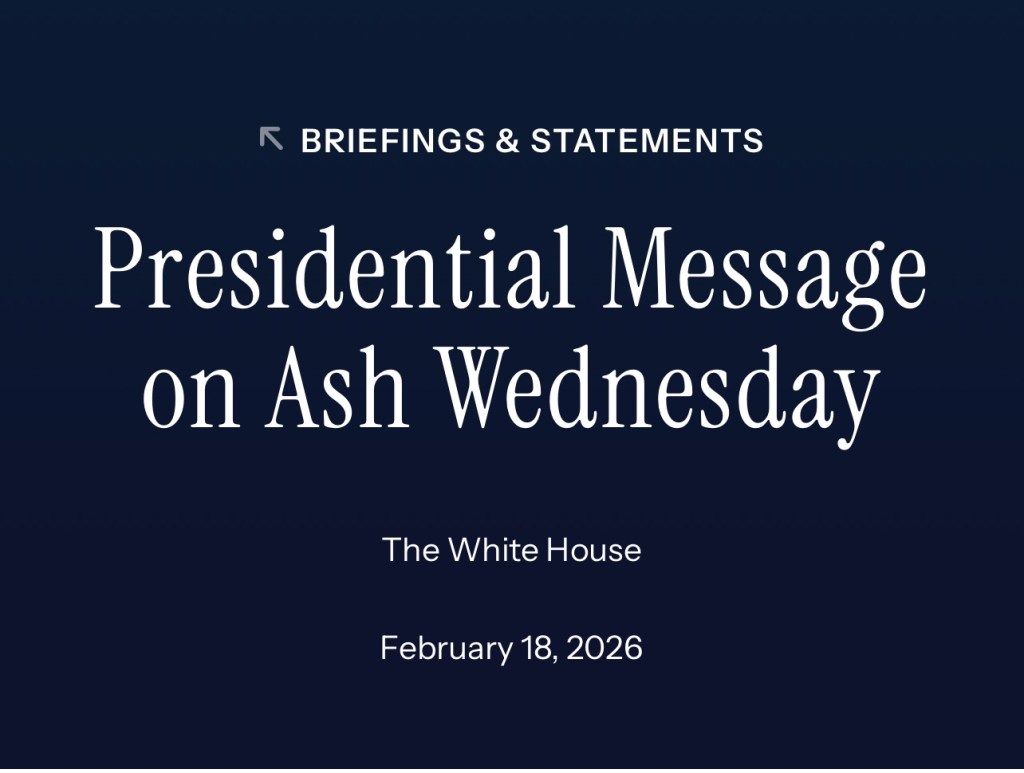
Ash Wednesday always arrives with a kind of quiet honesty. It does not shout. It does not campaign. It does not flatter. It simply presses a thumb of ashes onto our foreheads and tells the truth: Remember that you are dust, and to dust you shall return.
So when the White House issues a message about prayer, repentance, and the meaning of Lent, it naturally draws attention. Not because the themes are unusual—they are ancient and universal—but because they come from an administration whose leader has, in the past, publicly stated that he has never felt the need to repent. That he has done nothing wrong. That repentance is unnecessary for him.
This is not a stone thrown. It is simply a matter of public record, and it creates a tension worth naming.
For Christians, repentance is not a punishment. It is not humiliation. It is not a political liability. It is the doorway to truth, healing, and freedom. It is the spiritual equivalent of oxygen. To say one has no need of repentance is to say one has no need of God’s mercy—and that is a claim no human being can make honestly.
Even the most loyal evangelical supporters of the President know this. Many have said openly that moral character is not a requirement for national leadership, or that God can use anyone regardless of their flaws. And of course, God can. But that is different from saying flaws do not matter, or that repentance is optional for some and essential for others.
Ash Wednesday levels the ground. It refuses to let anyone—president or pauper—stand above the need for grace.
What makes this moment spiritually interesting is not the political contradiction but the theological one. A message about repentance coming from a leader who has rejected the concept invites us to reflect on how easily religious language can be used without being inhabited. How faith can be referenced without being practiced. How sacred words can be spoken without ever touching the heart.
And yet, perhaps this is precisely why the message matters.
Because Lent is not about who already understands repentance. It is about who is willing to begin.
It is about the possibility that even those who have never admitted wrongdoing might one day feel the weight of their own humanity. It is about the hope that even the powerful might discover the freedom that comes from telling the truth. It is about remembering that God’s mercy is not a political tool but a spiritual lifeline.
On this Saturday—this Sunday in other parts of the world—when people are a little more spiritually attuned, a little more open, a little more honest, we can hold this tension without cynicism. We can acknowledge the contradiction without losing hope. We can pray for leaders without excusing their actions. And we can remember that repentance is not a performance but a posture.
Ashes do not lie. They tell us who we are. And they remind us who we are not.
May this Lent be a season when truth is spoken, humility is rediscovered, and repentance becomes more than a word in a press release. May it become a way home.
The Editorial Room exists for readers who want more than the noise of the news cycle. This is a place to slow down, look closely, and consider what public events reveal about our institutions, our leaders, and the deeper questions beneath the headlines.
Here, the aim isn’t speed or spectacle. It’s clarity. It’s steadiness. It’s the kind of reflection that helps us understand not just what happened, but why it matters — and what it asks of us as citizens and human beings.
Some essays will respond to the moment. Others will step back and trace the longer arc of law, public life, and the human condition. All of them are written with the hope that this room becomes a small refuge for thoughtful readers.
If you’ve found your way here, welcome. May this be a place where understanding grows.