
There is a category error many people make when a religious leader speaks into public life.
They hear politics.
But what is being offered is moral witness.
A religious authority does not speak as a rival power to the state. The task is not to govern, mobilize voters, or draft policy. The task is simpler—and harder: to speak truthfully about human dignity, justice, mercy, and responsibility as revealed in the Gospel.
When that speech challenges a political leader, the instinct is to translate it into political terms.
Who is siding with whom?
Which party benefits?
Who is attacking whom?
That translation is the mistake.
The church does not address the state as a political opponent, but as a moral interlocutor.
This is not new. The Hebrew prophets spoke to kings. John the Baptist spoke to Herod. Across Christian history, the church has understood that power must be confronted by something it cannot command: conscience.
Many evangelicals struggle here, especially those shaped by decades of teaching that treats Catholic authority as inherently suspect or even hostile to the Gospel. Suspicion often precedes listening. Once the speaker is dismissed, the content never has a chance.
But Christian faith does not permit us to evaluate speech based on who speaks rather than what is said.
If a religious leader speaks in line with the Gospel—about care for the vulnerable, truthfulness, humility, or the restraint of power—then the speech must be weighed on those grounds alone. Agreement or disagreement should follow listening, not replace it.
Confusion deepens when political movements demand loyalty that rivals theological conviction. In such an environment, any moral critique feels like betrayal. Faith becomes tribal. The Gospel becomes partisan.
That is not evangelicalism at its best. And it is not Christianity.
Religious leaders are not called to be chaplains of the state, nor activists chasing relevance. They are called to bear witness—to speak plainly, even when it is inconvenient, even when it is misunderstood.
When moral speech is reduced to politics, everyone loses.
The state loses a necessary mirror.
The church loses its voice.
And the Gospel is flattened into just another opinion.
Clarity requires that we keep the categories straight.
Politics governs.
Faith speaks.
And sometimes, faith speaks to politics—not as an enemy, but as a reminder that power is never ultimate.
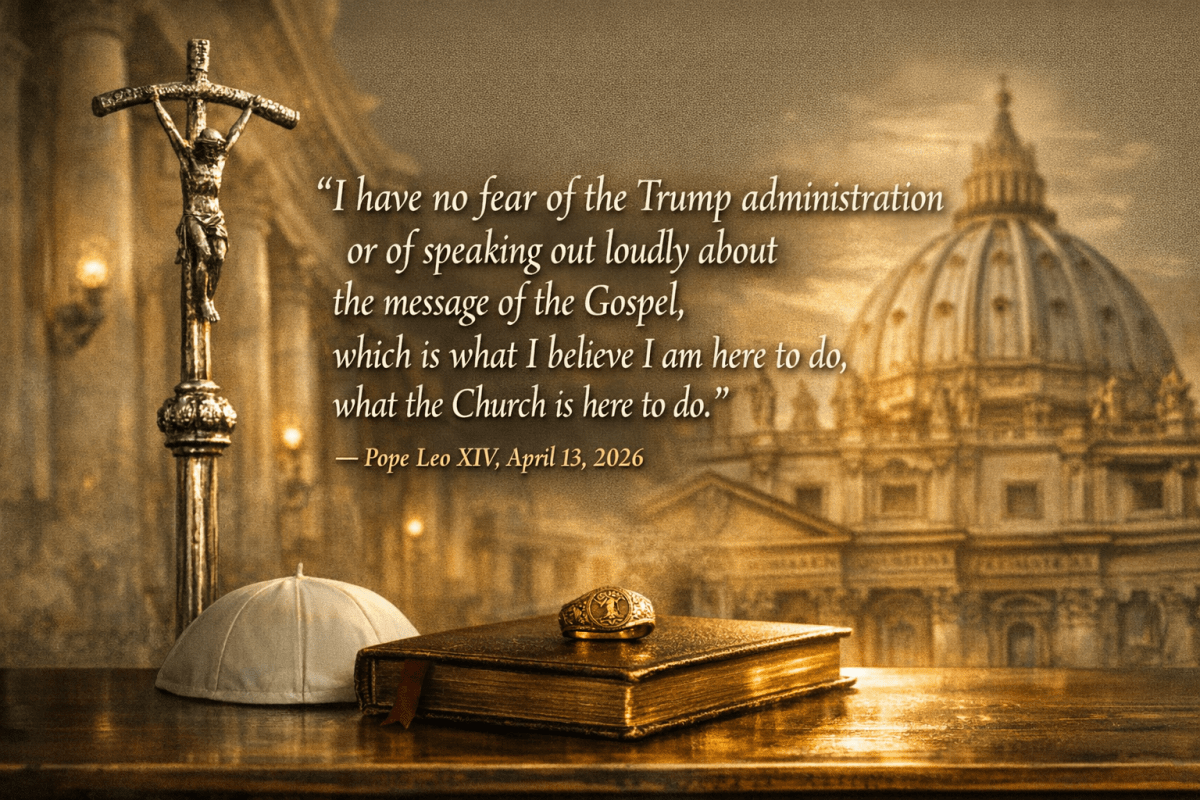
“I have no fear of the Trump administration or of speaking out loudly about the message of the Gospel, which is what I believe I am here to do, what the Church is here to do.”
— Pope Leo XIV, April 13, 2026
Discover more from The Editorial Room
Subscribe to get the latest posts sent to your email.
