
When Moral Speech Is Mistaken for Politics

There is a category error many people make when a religious leader speaks into public life.
They hear politics.
But what is being offered is moral witness.

A religious authority does not speak as a rival power to the state. The task is not to govern, mobilize voters, or draft policy. The task is simpler—and harder: to speak truthfully about human dignity, justice, mercy, and responsibility as revealed in the Gospel.

When that speech challenges a political leader, the instinct is to translate it into political terms.
Who is siding with whom?
Which party benefits?
Who is attacking whom?

That translation is the mistake.

The church does not address the state as a political opponent, but as a moral interlocutor.

This is not new. The Hebrew prophets spoke to kings. John the Baptist spoke to Herod. Across Christian history, the church has understood that power must be confronted by something it cannot command: conscience.

Many evangelicals struggle here, especially those shaped by decades of teaching that treats Catholic authority as inherently suspect or even hostile to the Gospel. Suspicion often precedes listening. Once the speaker is dismissed, the content never has a chance.

But Christian faith does not permit us to evaluate speech based on who speaks rather than what is said.

If a religious leader speaks in line with the Gospel—about care for the vulnerable, truthfulness, humility, or the restraint of power—then the speech must be weighed on those grounds alone. Agreement or disagreement should follow listening, not replace it.

Confusion deepens when political movements demand loyalty that rivals theological conviction. In such an environment, any moral critique feels like betrayal. Faith becomes tribal. The Gospel becomes partisan.

That is not evangelicalism at its best. And it is not Christianity.

Religious leaders are not called to be chaplains of the state, nor activists chasing relevance. They are called to bear witness—to speak plainly, even when it is inconvenient, even when it is misunderstood.

When moral speech is reduced to politics, everyone loses.
The state loses a necessary mirror.
The church loses its voice.
And the Gospel is flattened into just another opinion.

Clarity requires that we keep the categories straight.
Politics governs.
Faith speaks.
And sometimes, faith speaks to politics—not as an enemy, but as a reminder that power is never ultimate.

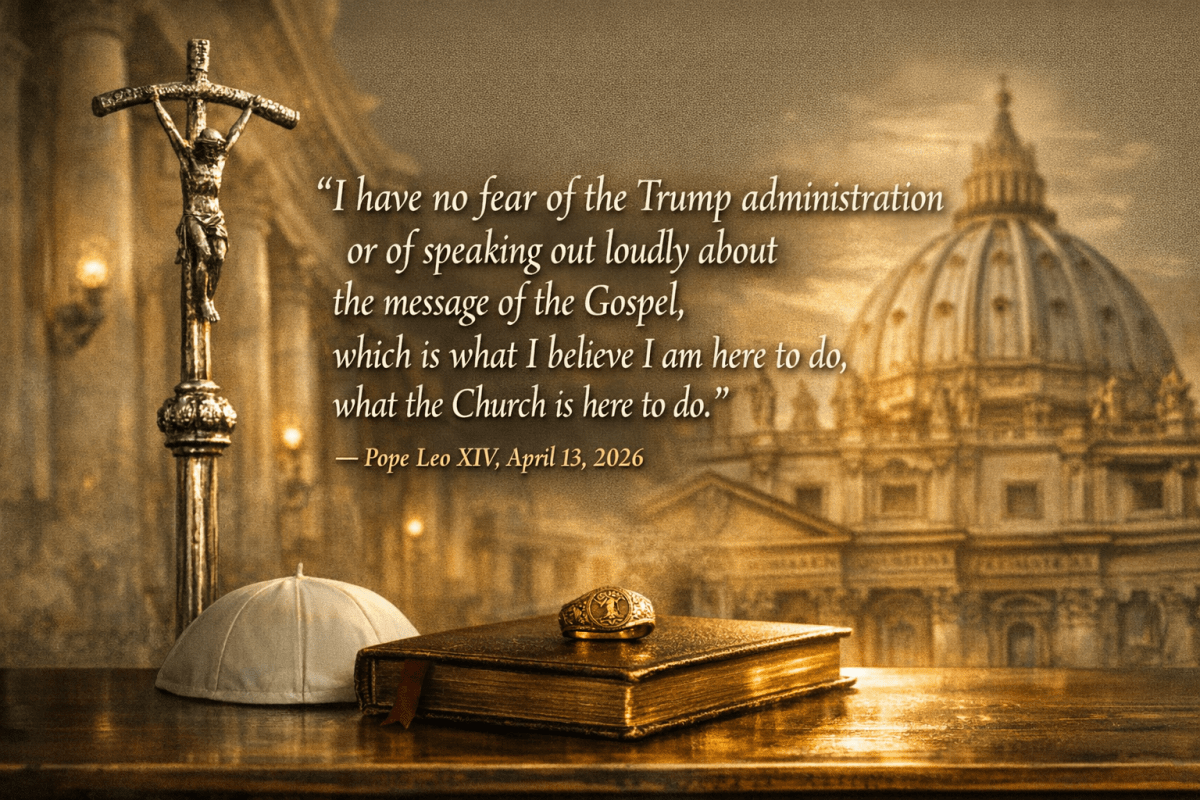
“I have no fear of the Trump administration or of speaking out loudly about the message of the Gospel, which is what I believe I am here to do, what the Church is here to do.”

— Pope Leo XIV, April 13, 2026
When Truth Is Reduced to a Screenshot: A Personal Appeal on Integrity and Witness

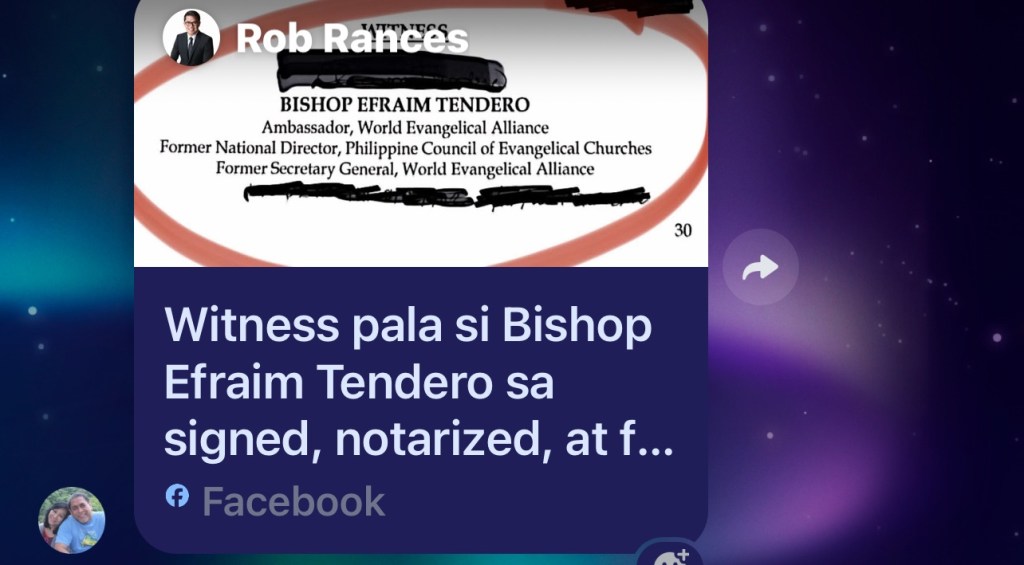
In the past few days, I’ve watched a familiar pattern unfold online: a fragment of information, lifted from its context, is turned into a weapon. A name is pulled into a narrative it did not choose. And a respected Christian leader — in this case, Bishop Efraim Tendero — becomes collateral damage in someone else’s political story.

I have known Bishop Tendero for years. He is a man of integrity, humility, and deep pastoral steadiness. So when I saw posts circulating that implied he had “certified” the truth of the Brave 18 affidavit — or worse, that he was a witness against those accused of bribing ICC investigators — I reached out to him directly.

His reply was immediate, clear, and consistent with the man I know.

“Two days before I left Manila for the series of conferences in the USA, I was asked to be a witness to the signing of a sworn statement by 18 men who were enlisted personnel of the Philippine Military before a notary public.

I confirm that I witnessed the 18 soldiers appear before the notary public, and the signing process took place.

As a witness, I don’t attest to the accuracy or truth of the statements made; I only confirm the signing process was legitimate.

The responsibility for the veracity of the document’s content lies with those who gave their sworn statements.”

This is the whole truth.
Nothing more.
Nothing less.

A witness to a notarization does not verify the truth of the statements. They verify identity, presence, and the act of signing. That is all. It is a procedural role, not a political endorsement. It is a matter of form, not of content.

And yet, some have taken his name — his good name — and used it to imply something he did not say, did not do, and did not intend.

This is where my concern deepens.

Because this is not just about Bishop Tendero.
It is about the way we handle truth when it is inconvenient to our preferred narrative.
It is about the ease with which we weaponize partial information to score political points.
It is about the spiritual cost of using another person’s integrity as a prop for our own agenda.

I say this with respect, and with a pastoral heart:
When we twist someone’s role to make our side look righteous and the other side look corrupt, we are no longer dealing in truth. We are dealing in manipulation.

And manipulation, even when done in the name of patriotism or loyalty, is still a form of bearing false witness.

I understand the passions surrounding the ICC case. I understand the loyalties, the fears, the hopes, and the wounds. But none of these justify misusing a pastor’s name to advance a political narrative. None of these justify implying that he verified allegations he did not verify. None of these justify dragging him into a fight he did not choose.

If we care about truth, then we must care about the whole truth — not just the parts that serve our side.

If we care about justice, then we must refuse to harm the innocent in the process.

And if we care about the witness of the Church, then we must be the first to resist the temptation to twist facts for political gain.

Bishop Tendero did what many pastors have done countless times: he witnessed a signing before a notary public. That is all. To turn that simple act into a political endorsement is not only misleading — it is unjust.

My appeal is simple:
Let us stop using people’s names as tools for our narratives.
Let us stop weaponizing partial truths.
Let us stop dragging pastors into political battles they did not enter.

Truth is not a slogan.
Truth is not a screenshot.
Truth is not a tool for winning arguments.

Truth is a discipline — one that demands humility, restraint, and the courage to say only what is real.

And in this moment, what is real is clear:
Bishop Tendero witnessed a signing.
He did not certify the truth of the allegations.
He did not take sides.
He did not enter the political arena.
Others placed him there.

For his sake — and for the sake of our own integrity — we should correct the record and let the truth stand on its own.