
KAPAG ANG KATOTOHANAN AY GINAGAWANG BALA: ANG ARAL SA “FAKE NEWS” LABAN KAY ATTY. ROMEL BAGARES

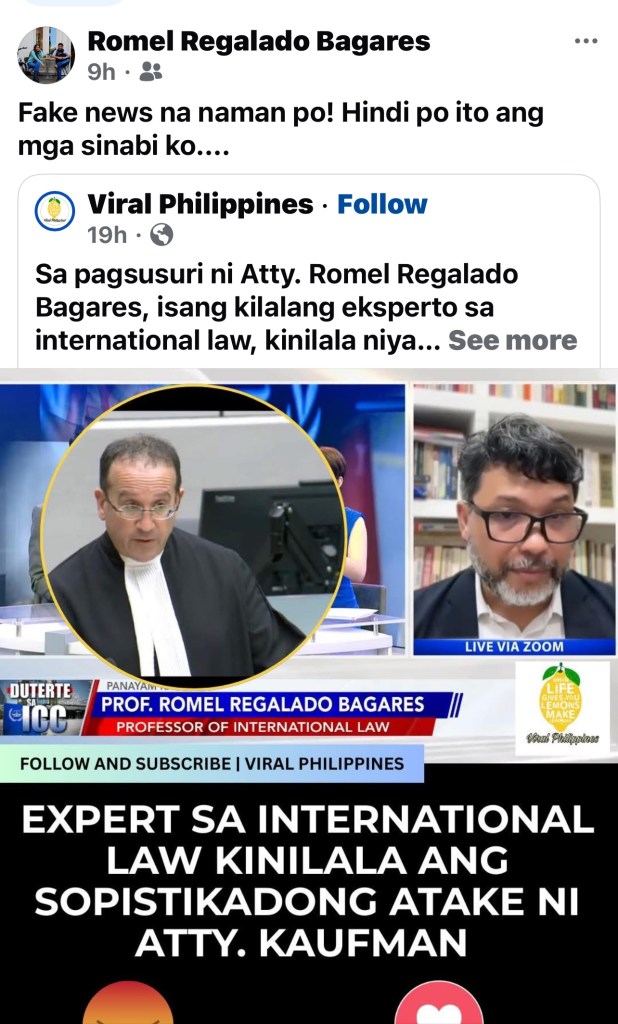
Sa Pilipinas, hindi na bago ang paggamit ng pangalan ng mga iginagalang na lider—obispo, abogado, propesor, pastor—para magtahi ng mga kuwentong hindi nila sinabi. Kahapon, ang pangalan ni Bishop Ef Tendero ang ginamit upang magmukhang may “witness” na pumapabor sa isang politikal na narrative. Ngayon, ang pangalan naman ni Atty. Romel Regalado Bagares, isang kilalang eksperto sa international law, ang ginawang kasangkapan sa parehong paraan.

At tulad ng ginawa ni Bishop Tendero, mabilis at malinaw ang tugon ni Atty. Bagares: “Fake news na naman po! Hindi po ito ang mga sinabi ko…”

Hindi ito basta reklamo. Ito ay pagwawasto. At higit pa roon, ito ay babala.

Ang Inimbentong Kwento Sa isang post ng Viral Philippines, ipininta si Atty. Bagares na para bang tagahanga ng depensa ni Atty. Nicholas Kaufman sa ICC hearings. Ayon sa post, pinuri raw niya ang “sopistikadong atake” ng depensa, inisa‑isa ang mga “brilliant” moves ni Kaufman, at ipinakita pang tila mas kapani‑paniwala ang narrative ng depensa kaysa sa Prosecution.

Ang problema? Wala sa mga ito ang sinabi ni Atty. Bagares. Hindi sa interview. Hindi sa anumang public commentary. Hindi kailanman. At mismong siya ang nagsabi nito.

Ano Ba Talaga ang Sinabi ni Atty. Bagares?
Sa mga totoong interview at public analyses na napanood ko, malinaw ang tono at nilalaman ng kanyang paliwanag:

– Ang focus niya ay sa Prosecution, hindi sa depensa. – Pinuri niya ang pagiging “systematic” at “on point” ng Prosecution sa paglatag ng ebidensya. – Wala siyang binanggit na papuri kay Kaufman. – Wala siyang sinabi tungkol sa “linguistic defense,” “political contextualization,” o pag-atake sa insider witnesses. – Wala siyang anumang pahayag na maaaring basahin bilang pro‑Duterte o pro‑defense. – Ang kanyang boses ay legal, maingat, at tapat—hindi sensational, hindi partisan, at hindi ginagamit para magtahi ng political spin.

Kaya malinaw kung bakit mabilis ang kanyang pagtanggi. Hindi lang ito maling quote. Ito ay pagkatha.

Ang Mas Malaking Sugat
Ang mga ganitong post ay hindi ginagawa para sa mga may kakayahang mag-fact-check. Ginagawa ito para sa mga walang access sa tamang impormasyon, sa mga umaasa sa forwarded posts, sa mga pagod na sa ingay ng politika, at sa mga Pilipinong naghahanap ng simpleng paliwanag sa komplikadong usapin.

Sa madaling salita: ginagawa ito para sa mga ordinaryong tao—lalo na ang mga mahihirap—na walang sandata laban sa disinformation.

At dito nagiging moral ang usapin.

Ang Katotohanan ay Hindi Lang Legal—Ito ay Moral
Sa bansang tinatawag ang sarili na “the only Christian nation in Asia,” hindi sapat ang pagiging relihiyoso kung hindi natin kayang igalang ang katotohanan.

Kung ang pangalan ng isang bishop ay maaaring gamitin para sa kasinungalingan, at ang pangalan ng isang abogado ay maaaring gamitin para sa imbentong analysis, ano pa ang hindi kayang baluktutin?

Kung ang mga Kristiyano mismo ay hindi marunong kumilatis, hindi marunong tumanggi, hindi marunong magsabi ng “mali ito,” kanino pa aasang magtatanggol sa katotohanan?

Ang Panawagan
Hindi ito tungkol sa Duterte. Hindi ito tungkol sa ICC. Hindi ito tungkol sa politika.

Ito ay tungkol sa katotohanan, at kung paano natin ito pinoprotektahan.

Sa panahon ng disinformation, ang pinakamaliit na kabutihan ay ang pagtanggi sa kasinungalingan. At ang pinakamalaking kabayanihan ay ang pagtindig para sa totoo—kahit hindi ito popular, kahit hindi ito komportable.

Kung tunay tayong Kristiyano, kung tunay tayong Pilipino, kung tunay tayong may malasakit sa bayan, dapat nating piliin ang katotohanan—hindi dahil madali, kundi dahil ito ang tama.
When Truth Is Reduced to a Screenshot: A Personal Appeal on Integrity and Witness

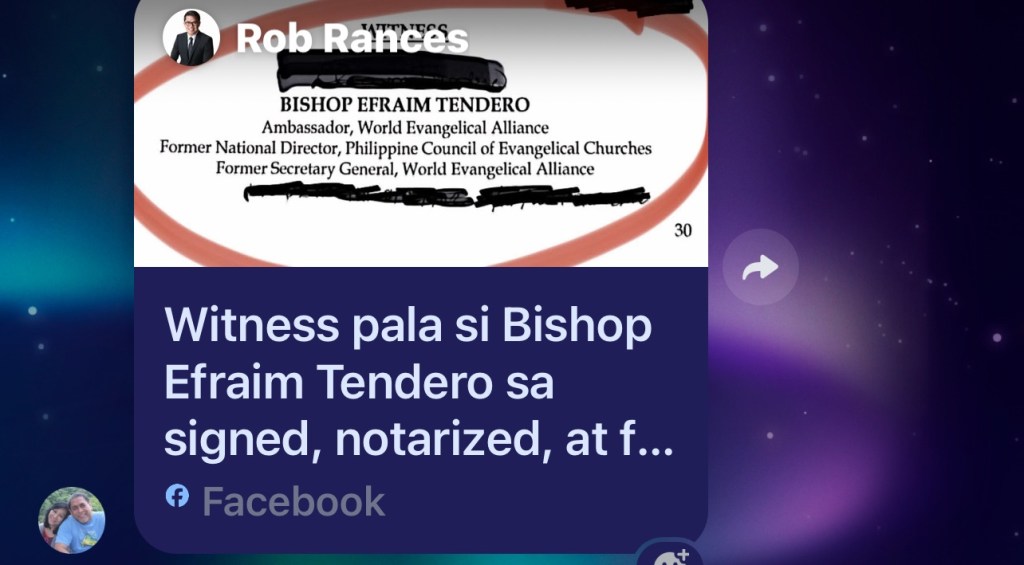
In the past few days, I’ve watched a familiar pattern unfold online: a fragment of information, lifted from its context, is turned into a weapon. A name is pulled into a narrative it did not choose. And a respected Christian leader — in this case, Bishop Efraim Tendero — becomes collateral damage in someone else’s political story.

I have known Bishop Tendero for years. He is a man of integrity, humility, and deep pastoral steadiness. So when I saw posts circulating that implied he had “certified” the truth of the Brave 18 affidavit — or worse, that he was a witness against those accused of bribing ICC investigators — I reached out to him directly.

His reply was immediate, clear, and consistent with the man I know.

“Two days before I left Manila for the series of conferences in the USA, I was asked to be a witness to the signing of a sworn statement by 18 men who were enlisted personnel of the Philippine Military before a notary public.

I confirm that I witnessed the 18 soldiers appear before the notary public, and the signing process took place.

As a witness, I don’t attest to the accuracy or truth of the statements made; I only confirm the signing process was legitimate.

The responsibility for the veracity of the document’s content lies with those who gave their sworn statements.”

This is the whole truth.
Nothing more.
Nothing less.

A witness to a notarization does not verify the truth of the statements. They verify identity, presence, and the act of signing. That is all. It is a procedural role, not a political endorsement. It is a matter of form, not of content.

And yet, some have taken his name — his good name — and used it to imply something he did not say, did not do, and did not intend.

This is where my concern deepens.

Because this is not just about Bishop Tendero.
It is about the way we handle truth when it is inconvenient to our preferred narrative.
It is about the ease with which we weaponize partial information to score political points.
It is about the spiritual cost of using another person’s integrity as a prop for our own agenda.

I say this with respect, and with a pastoral heart:
When we twist someone’s role to make our side look righteous and the other side look corrupt, we are no longer dealing in truth. We are dealing in manipulation.

And manipulation, even when done in the name of patriotism or loyalty, is still a form of bearing false witness.

I understand the passions surrounding the ICC case. I understand the loyalties, the fears, the hopes, and the wounds. But none of these justify misusing a pastor’s name to advance a political narrative. None of these justify implying that he verified allegations he did not verify. None of these justify dragging him into a fight he did not choose.

If we care about truth, then we must care about the whole truth — not just the parts that serve our side.

If we care about justice, then we must refuse to harm the innocent in the process.

And if we care about the witness of the Church, then we must be the first to resist the temptation to twist facts for political gain.

Bishop Tendero did what many pastors have done countless times: he witnessed a signing before a notary public. That is all. To turn that simple act into a political endorsement is not only misleading — it is unjust.

My appeal is simple:
Let us stop using people’s names as tools for our narratives.
Let us stop weaponizing partial truths.
Let us stop dragging pastors into political battles they did not enter.

Truth is not a slogan.
Truth is not a screenshot.
Truth is not a tool for winning arguments.

Truth is a discipline — one that demands humility, restraint, and the courage to say only what is real.

And in this moment, what is real is clear:
Bishop Tendero witnessed a signing.
He did not certify the truth of the allegations.
He did not take sides.
He did not enter the political arena.
Others placed him there.

For his sake — and for the sake of our own integrity — we should correct the record and let the truth stand on its own.