
(Readers should confirm all political details with trusted sources.)
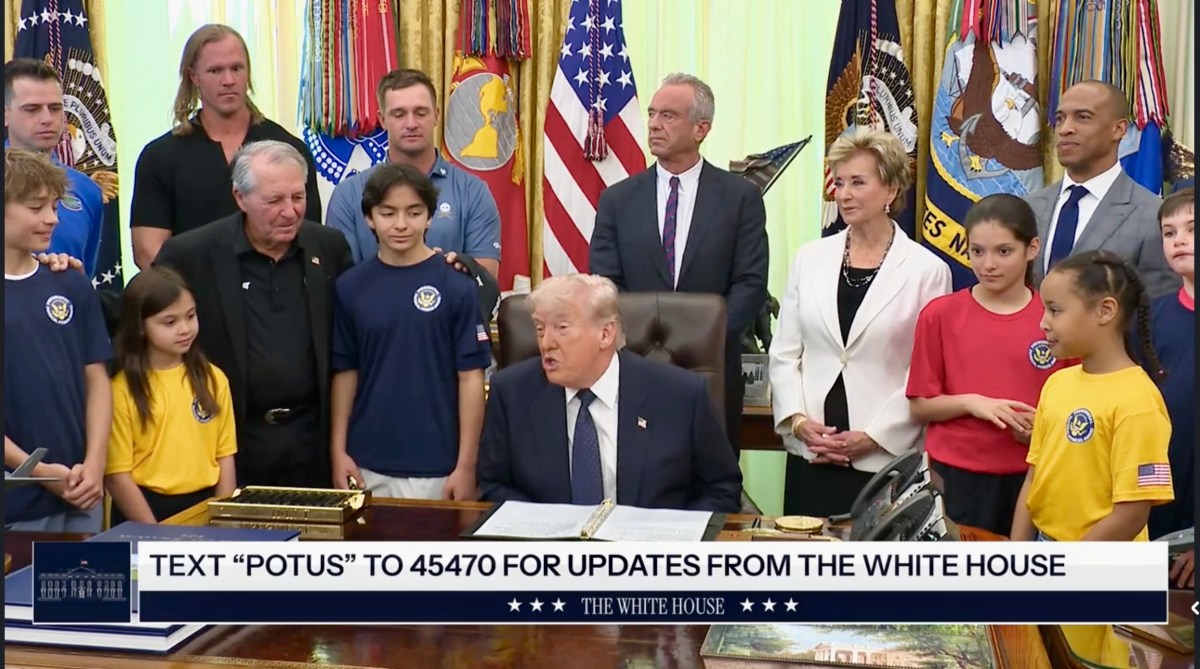
There are moments in civic life when a public proclamation lands with a weight that is not entirely its own. President Donald Trump’s recent call to revive a national youth physical fitness test is one such moment. On the surface, it resembles the familiar rituals of school gymnasiums — the shuttle run, the pull‑up bar, the stopwatch in a coach’s hand. But beneath the nostalgia lies a deeper question about how a nation imagines its future, and what it asks of its children.
This reflection is not about equivalence. It is about discernment — the quiet, necessary work of noticing the shape of things as they unfold.
The Young as a Mirror of National Longing
Every society, especially in seasons of uncertainty, turns its gaze toward the young. They become the canvas on which a nation paints its hopes, anxieties, and unfinished dreams. Throughout the last century, governments of many kinds — democratic, authoritarian, and everything in between — have used youth programs to cultivate a particular vision of citizenship.
Physical fitness often becomes the doorway. It is tangible. It is measurable. It carries symbolic weight. A strong body can be framed as a sign of a strong nation.
But history teaches us that when a government turns its attention to the bodies of the young, it is rarely only about health.
It is about formation.
A Pattern Older Than Any One Leader
Across the 20th century, a recognizable pattern emerges:
- Youth are framed as the key to national renewal.
- Programs begin with fitness, discipline, and shared activity.
- Physical training slowly blends with civic or ideological messaging.
- Alternative spaces for youth formation narrow.
- The young become symbols of the nation’s desired identity.
The most extreme examples — Nazi Germany, Fascist Italy, Maoist China — are not invoked here as comparisons, but as reminders of how easily physical formation can become moral formation, and how quickly moral formation can become political formation.
The pattern is not about a particular leader. It is about the architecture of influence.
Why This Moment Deserves Attention
Trump’s proclamation does not recreate the systems of the past. But it does echo the early moves that historians often notice when leaders speak of youth fitness in the language of national destiny:
- a narrative of decline
- a call for renewed discipline
- a symbolic use of youth as carriers of national strength
- a leader‑centered vision of what the next generation should embody
These elements are not inherently dangerous. They are, however, historically resonant. They invite us to listen closely to the story being told beneath the policy.
The Question Beneath the Question
Physical activity is good for children. Communities should encourage it. Schools should support it. The concern is not the test itself but the imagination behind it.
A democracy must ask:
- What kind of strength are we cultivating?
- What virtues are being attached to the young body?
- What vision of citizenship is implied?
- And who is shaping that vision?
Youth formation is healthiest when it is plural — when families, schools, religious communities, civic groups, the arts, and the natural world all have a voice. When that landscape narrows, even subtly, the tone of a society shifts.
The Sanctuary of Discernment
At TEdR, we return often to the idea of sanctuary — not as escape, but as clarity. A place where the noise of public life quiets enough for us to hear the deeper currents beneath it.
Trump’s proclamation invites such sanctuary. It invites us to pause, to breathe, to ask what story is being told about our children and our future. It invites us to remember that youth programs are never just about youth. They are about the kind of society we are becoming, and the kind of citizens that future requires.
The work before us is not to react, but to discern. Not to fear, but to stay awake. Not to assume the worst, but to refuse to look away.
In the end, the question is simple and ancient:
What do we believe a child is for?
Everything else flows from that.
Discover more from The Editorial Room
Subscribe to get the latest posts sent to your email.
