
Outruns Truth: A Reflection on Leadership and the Markets

Author’s Note: I write this reflection not as an economist, but as someone who cares deeply about the integrity of public life. My concern is not partisan; it is human. In a time when narratives often outrun the truth, I believe we owe one another the courtesy of accuracy, humility, and respect. Leadership is strongest when it tells the truth plainly, without stretching it to fit a desired story. This piece is offered in that spirit.

In his recent State of the Union Address, President Trump spoke with confidence about the strength of the stock market under his leadership. It was a bold claim, delivered with the certainty that often accompanies political speeches. But as I listened, something in me hesitated. Not out of cynicism, but out of a simple desire for truthfulness — the kind that does not stretch itself to fit a narrative.

The numbers tell a different story.

The market’s strongest gains — the remarkable climb of 2023, 2024, and the early part of 2025 — all happened before the current administration began. Those gains were already in motion long before January 2025. They were shaped by global recovery cycles, Federal Reserve policy, technological expansion, and the resilience of American companies. They were not the product of a single leader, and certainly not the product of a term that had barely begun.

Yet in the SONA, those years were gathered up and presented as evidence of presidential accomplishment.

This is where my concern lies. Not in the politics, but in the integrity of the claim.

Economists across the spectrum have long said that presidents do not control the stock market. They influence sentiment, yes. They can shape policy, yes. But the market responds to forces far larger and more complex than any one administration: global supply chains, interest rates, inflation cycles, technological innovation, geopolitical tensions, and the decisions of millions of investors acting independently.

To claim personal credit for a multi‑year rise that predates one’s term is, at best, an oversimplification. At worst, it is a quiet rewriting of the timeline — a way of gathering unearned accomplishments into one’s own narrative.

And I say this not as a partisan critique, but as a human concern.

Because leadership, at its best, is not about claiming what one has not done. It is about telling the truth even when the truth is less flattering. It is about acknowledging the work of others, the complexity of systems, and the limits of one’s own influence. It is about resisting the temptation to turn every good thing into a personal victory.

What troubles me is not the boast itself, but the pattern it represents — a pattern in which public claims drift away from public reality, and the distance between the two becomes normalized. When that happens, trust erodes. And when trust erodes, institutions weaken.

I am not asking for perfection. I am asking for honesty.

A leader does not need to own the stock market to lead well. A leader does not need to claim credit for what came before. A leader does not need to bend the timeline to appear successful.

What we need — what I long for — is a leadership that is simple, truthful, respectful, and grounded. A leadership that does not fear humility. A leadership that can say, “This rise began before me,” and still stand tall.

In a world already strained by misinformation and narrative‑shaping, truthfulness is not a luxury. It is a responsibility.

And it is one we should expect from anyone who asks to lead us.
When Truth Is Reduced to a Screenshot: A Personal Appeal on Integrity and Witness

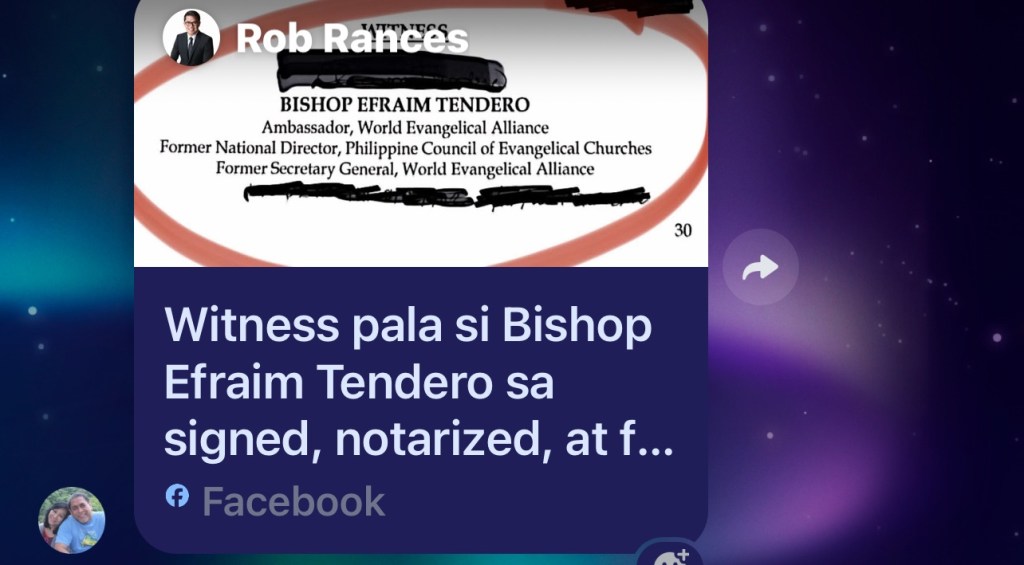
In the past few days, I’ve watched a familiar pattern unfold online: a fragment of information, lifted from its context, is turned into a weapon. A name is pulled into a narrative it did not choose. And a respected Christian leader — in this case, Bishop Efraim Tendero — becomes collateral damage in someone else’s political story.

I have known Bishop Tendero for years. He is a man of integrity, humility, and deep pastoral steadiness. So when I saw posts circulating that implied he had “certified” the truth of the Brave 18 affidavit — or worse, that he was a witness against those accused of bribing ICC investigators — I reached out to him directly.

His reply was immediate, clear, and consistent with the man I know.

“Two days before I left Manila for the series of conferences in the USA, I was asked to be a witness to the signing of a sworn statement by 18 men who were enlisted personnel of the Philippine Military before a notary public.

I confirm that I witnessed the 18 soldiers appear before the notary public, and the signing process took place.

As a witness, I don’t attest to the accuracy or truth of the statements made; I only confirm the signing process was legitimate.

The responsibility for the veracity of the document’s content lies with those who gave their sworn statements.”

This is the whole truth.
Nothing more.
Nothing less.

A witness to a notarization does not verify the truth of the statements. They verify identity, presence, and the act of signing. That is all. It is a procedural role, not a political endorsement. It is a matter of form, not of content.

And yet, some have taken his name — his good name — and used it to imply something he did not say, did not do, and did not intend.

This is where my concern deepens.

Because this is not just about Bishop Tendero.
It is about the way we handle truth when it is inconvenient to our preferred narrative.
It is about the ease with which we weaponize partial information to score political points.
It is about the spiritual cost of using another person’s integrity as a prop for our own agenda.

I say this with respect, and with a pastoral heart:
When we twist someone’s role to make our side look righteous and the other side look corrupt, we are no longer dealing in truth. We are dealing in manipulation.

And manipulation, even when done in the name of patriotism or loyalty, is still a form of bearing false witness.

I understand the passions surrounding the ICC case. I understand the loyalties, the fears, the hopes, and the wounds. But none of these justify misusing a pastor’s name to advance a political narrative. None of these justify implying that he verified allegations he did not verify. None of these justify dragging him into a fight he did not choose.

If we care about truth, then we must care about the whole truth — not just the parts that serve our side.

If we care about justice, then we must refuse to harm the innocent in the process.

And if we care about the witness of the Church, then we must be the first to resist the temptation to twist facts for political gain.

Bishop Tendero did what many pastors have done countless times: he witnessed a signing before a notary public. That is all. To turn that simple act into a political endorsement is not only misleading — it is unjust.

My appeal is simple:
Let us stop using people’s names as tools for our narratives.
Let us stop weaponizing partial truths.
Let us stop dragging pastors into political battles they did not enter.

Truth is not a slogan.
Truth is not a screenshot.
Truth is not a tool for winning arguments.

Truth is a discipline — one that demands humility, restraint, and the courage to say only what is real.

And in this moment, what is real is clear:
Bishop Tendero witnessed a signing.
He did not certify the truth of the allegations.
He did not take sides.
He did not enter the political arena.
Others placed him there.

For his sake — and for the sake of our own integrity — we should correct the record and let the truth stand on its own.