
When a president keeps advancing a policy the Supreme Court has already rejected, the issue is no longer just immigration—it’s constitutional muscle‑testing. President Trump’s renewed push to narrow birthright citizenship, despite a clear ruling from the Court, signals an administration determined to probe the limits of executive power. But beneath the legal maneuvering lies a deeper political motivation: a worldview that treats whiteness as the default and multiracial America as a deviation to be corrected.
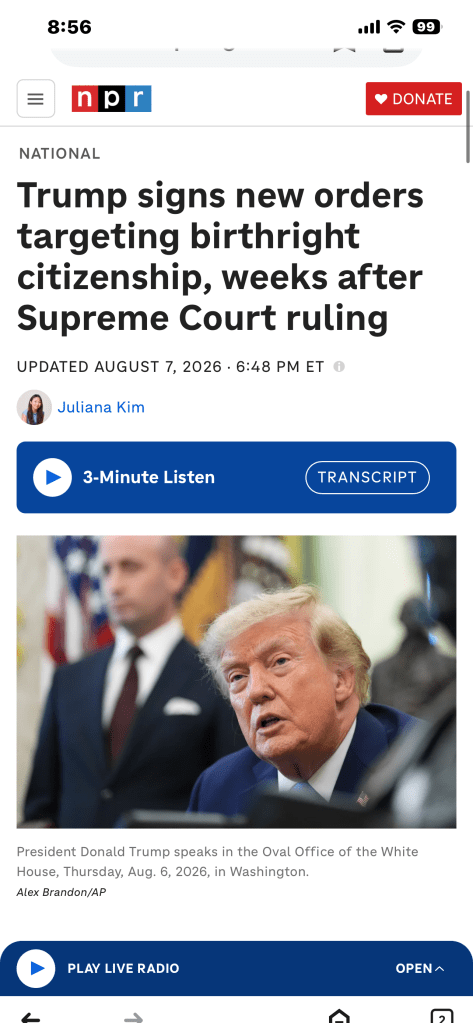
“President Trump is once again attempting to put restrictions on who is automatically guaranteed citizenship after being born in the U.S., just weeks after the Supreme Court ruled the president’s attempt to end birthright citizenship was unconstitutional.”
The United States has long told a story about itself—one of openness, of immigrants shaping the nation’s character, of a multiracial democracy that, while imperfect, strives toward inclusion. This administration has never hidden its rejection of that story. The language of “invasion,” the portrayal of non‑white migrants as existential threats, and the repeated attempts to redefine who belongs here are not rhetorical accidents. They are ideological choices. These new executive orders, narrower and more technical than the ones struck down in June, continue that project: to shrink the circle of belonging by carving out exceptions that disproportionately target non‑white families.
This is not simply policy persistence; it is narrative persistence. When a president treats a Supreme Court rebuke as an invitation to try again, it reveals a strategy aimed at normalizing exclusion—making it seem reasonable, even inevitable, that America should retreat from its multiracial identity. The administration is not only testing constitutional boundaries; it is testing the nation’s willingness to accept a reimagined American identity where diversity is framed as a liability rather than a defining strength.
The deeper danger is not the executive order itself, but the erosion of imagination. If we begin to accept that belonging can be narrowed by decree, that citizenship can be reinterpreted to fit an ideology, that multiracial democracy is optional rather than essential, then the constitutional guarantee becomes a technicality instead of a promise. The question is no longer whether these orders will survive judicial scrutiny. It is whether we still recognize the America we claim to be—and whether we are willing to defend it before the boundaries of belonging are redrawn beyond recognition.
