Queen of Qlay: A Filipino Dream for Alex Eala

By Ed Fernandez

There’s a certain kind of morning only Filipinos understand — a quiet cup of coffee, soft music in the background, and a mind that drifts toward people we root for as if they were family. Today, mine drifted toward Alex Eala, our 21‑year‑old tennis star who carries not just a racket, but the hopes of a nation that loves an underdog story.

Alex trained at the Rafa Nadal Academy in Spain, and you can see it in her game. When she unleashes one of those heavy, unreturnable, Rafa‑like forehands — the kind that seems to bounce twice before the opponent even reacts — you feel the Spanish clay in her DNA. It’s not imitation. It’s formation.

And it makes me wonder:
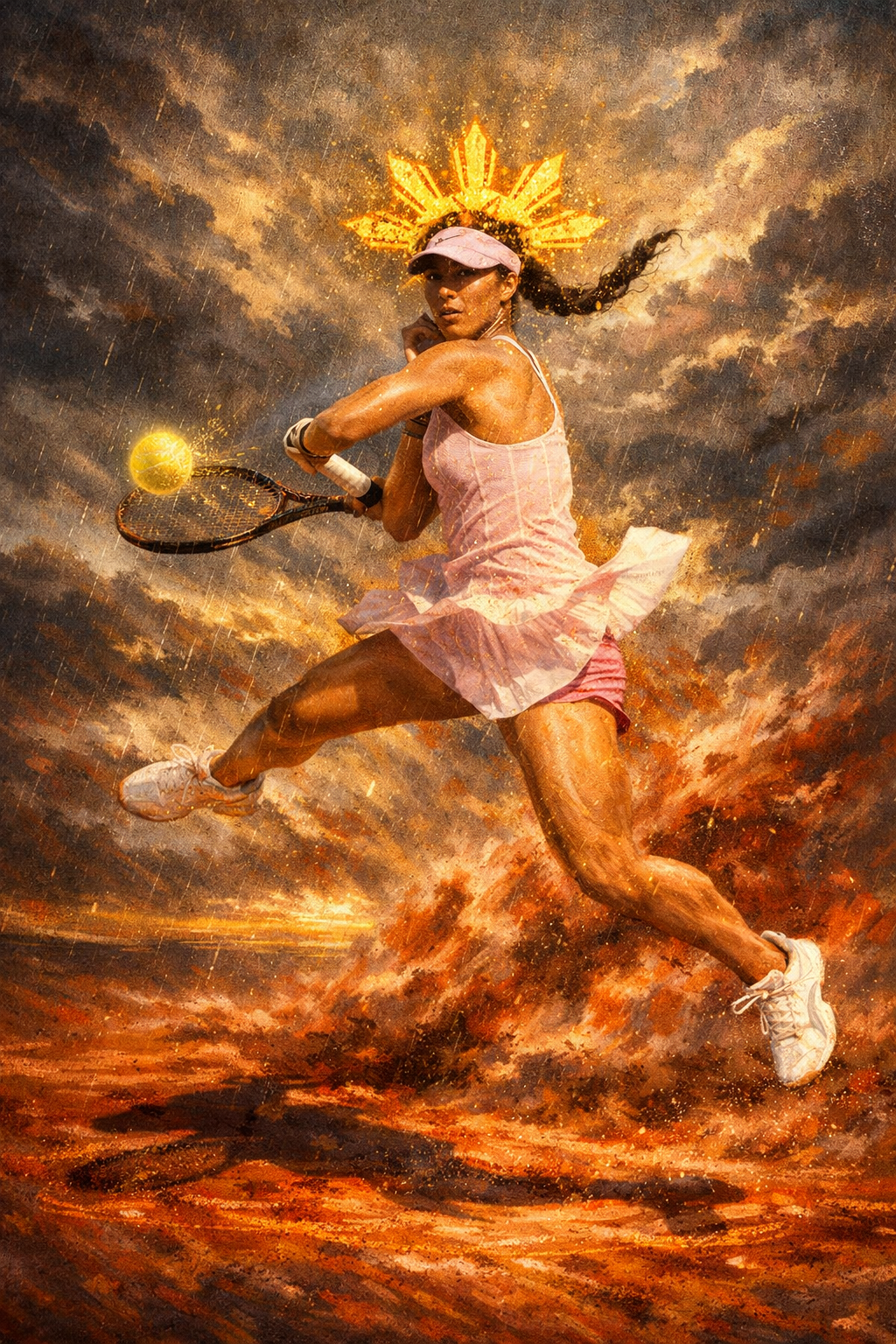
Could Alex Eala become the Queen of Qlay?

Yes, “Qlay” with a Q — a spelling that looks a little quirky, a little camp, a little proudly Pinoy. But that’s exactly why it works. “Clay” is a surface. “Qlay” is a title. It’s a crown. It’s a nickname only Filipinos could invent — playful, affectionate, and slightly prophetic.

But can she wear it?

Let’s be honest: clay is not yet Alex’s strongest surface. Her recent results show early exits in Madrid, Rome, and Roland Garros. Her hard‑court performances are stronger, her movement more confident, her shot tolerance more reliable.

But clay is also the surface she was trained to understand. The Nadal Academy teaches more than technique — it teaches patience, discipline, and the art of constructing points like architecture. Alex has that foundation. She has the topspin, the rally tolerance, the tactical clarity. What she needs now is refinement: the sliding, the balance, the instinctive adjustments that turn clay players into clay queens.

Her coach even says clay is her “greenest” surface. That’s not criticism. That’s opportunity.

The Serve She Needs — and the Serve She’s Building

If Alex wants to break into the top ten, she needs a stronger serve. The numbers show it. But she’s working on it. Her team knows it. And at 21, she has time to build the kind of serve that doesn’t just start the point — it dictates it.

Modern clay isn’t just about patience. It’s about power. Swiatek, Sabalenka, Rybakina — they don’t just survive rallies; they impose themselves. Alex will need to return power with power, to deliver more of those Rafa‑like heavy returns, and to slice with intention rather than desperation.

She has the tools. She needs the sharpening.

A Filipina on Red Dust

So can she become the Queen of Qlay?

Not yet.
But the possibility is real — and deeply Filipino.

Alex has:

  • the discipline
  • the Nadal training
  • the tactical mind
  • the humility
  • the cultural fire
  • the youth
  • the narrative

And she has something else — something Filipinos recognize instantly: a quiet, grounded joy. She doesn’t play angry. She plays present. She plays awake. She plays with that calm intensity we see in athletes who carry their country in their chest, not on their shoulders.

If she continues to evolve — if she strengthens her serve, refines her movement, and leans into the power exchanges that define modern clay — she could become not just a contender, but a force.

“Queen of Qlay” may sound playful now, but Filipino nicknames often begin as jokes and end as destiny.

Alex Eala is not done becoming.
And the red dust may yet be her throne.


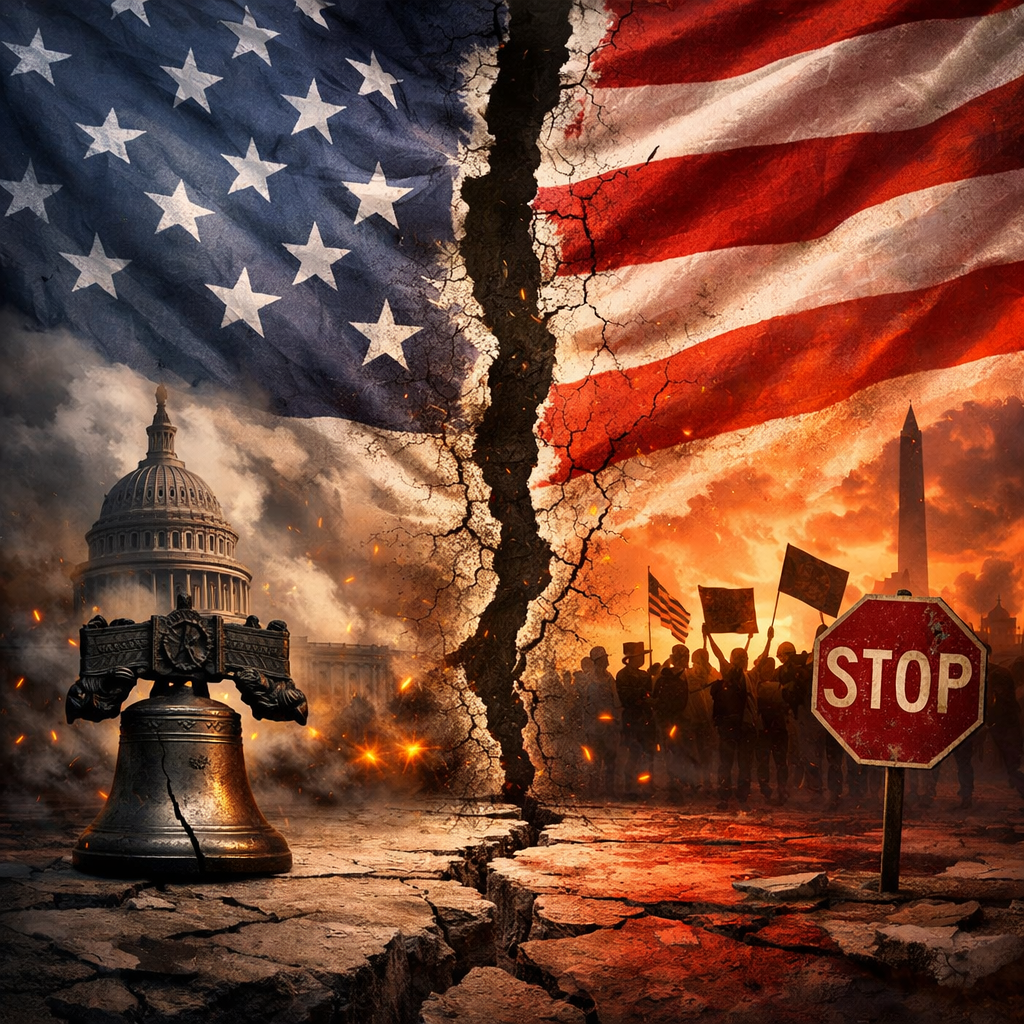
The Fourth of July and the Fracturing of the American Imagination

Independence Day is meant to be our annual civic reset—a moment when Americans remember that the republic was not founded on uniformity, but on a shared commitment to freedom, argument, and responsibility. It is the one holiday that belongs equally to every citizen, regardless of party, persuasion, or grievance.

This year, that shared space narrowed.

As The Atlantic observed, “Trump’s July 4 message was not a celebration of America. It was a declaration of conflict.” The holiday greeting, traditionally a gesture of national unity, instead framed the country as divided into the loyal and the disloyal, the deserving and the suspect. It was less a commemoration of independence than a warning shot across the civic landscape.

When Patriotism Becomes a Sorting Mechanism

Patriotism has always carried tension—between critique and devotion, between aspiration and reality. But it has rarely been reduced to personal allegiance to a single figure. When national identity is defined by loyalty to one leader, dissent becomes betrayal. Institutions become obstacles. Neighbors become threats.

The Atlantic piece notes that Trump “speaks of the nation as if it is already split into the loyal and the disloyal—and only one side deserves to win.” That framing is not merely divisive; it is corrosive. It trains citizens to imagine the country as a battlefield rather than a shared inheritance.

The Rhetoric of Permanent Emergency

The danger in conflict‑centered messaging is not only what it says, but what it normalizes. When leaders describe the nation as being in internal crisis, people begin to behave as if crisis is the natural state of democracy. When leaders portray opponents as enemies, supporters begin to treat disagreement as existential. When leaders insist that only they can save the nation, the institutions designed to protect the nation become expendable.

This is how polarization becomes a worldview rather than a moment.

Recovering the Civic Imagination

The work before us is not to match rhetoric with counter‑rhetoric, but to recover the civic imagination itself. Democracy requires a discipline of mind and heart: the ability to hold convictions without surrendering curiosity, to argue without erasing the humanity of the person across from us, to remember that patriotism is not a weapon but a responsibility.

July 4 should not be a stage for grievance. It should be a reminder that the American experiment survives only when citizens refuse to let fear or personality eclipse the shared work of self‑government.

A Closing Reflection

If Independence Day becomes a battlefield briefing, then the republic loses one of its few remaining rituals of common identity. The task now is stubbornly simple: to insist that the nation belongs to all of us, not to the loudest voice or the angriest grievance.

Patriotism is not a declaration of conflict. It is a commitment to each other—and to the fragile, unfinished project we call America.

Carrying the Grass: Alex Eala and the Fellowship of Fighters

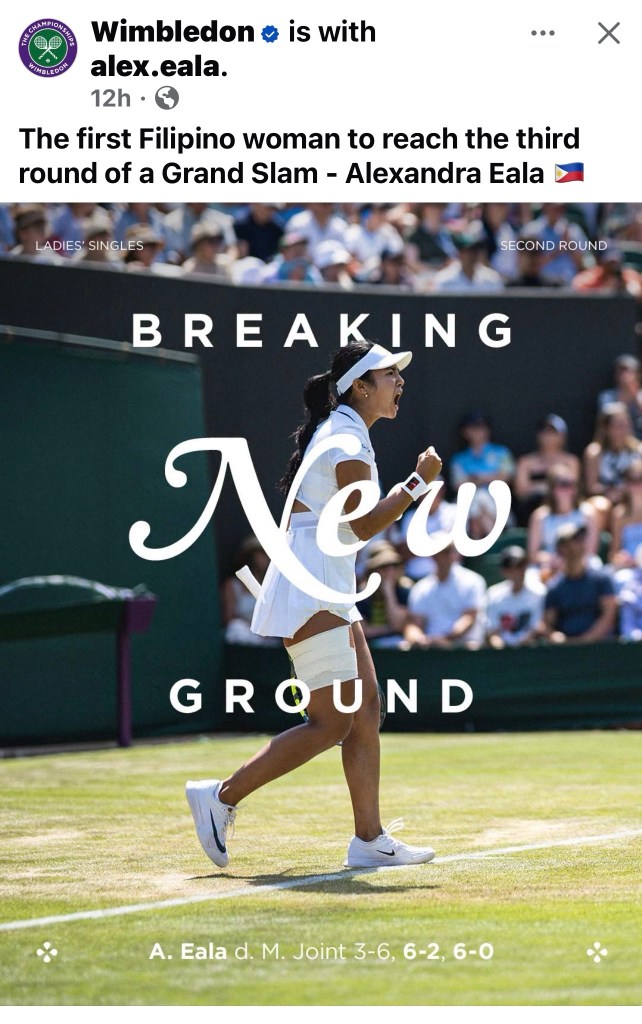
There are victories that belong to the scoreboard, and there are victories that belong to the human spirit. Alex Eala’s breakthrough at Wimbledon belongs unmistakably to the latter.

Alex Eala (Wimbledon Photo Facebook*)

Her performance on the grass courts did more than advance her career; it illuminated a truth that resonates far beyond tennis. It reminded us that greatness often emerges from places where resources are thin, expectations are heavy, and the odds are rarely fair. And yet, some people rise anyway.

Filipinos everywhere felt that rise. But this moment was not ours alone. It belonged to anyone who has ever fought uphill—athletes from small federations, dreamers from overlooked communities, families who stretch their courage across generations. It belonged to those who train on borrowed courts, those who travel only when someone else can sponsor the fare, those who carry their loved ones’ hopes in their bags alongside their gear.

Alex played for all of them.

Alex on Served+

What made her Wimbledon run even more striking was how it aligned with the deeper conversation unfolding in tennis today. Andy Roddick’s recent reflections on Served captured the modern athlete’s reality: pressure that is more public, more relentless, more intertwined with identity. The court is no longer just a court; it is a stage where narratives, expectations, and global scrutiny converge.

And yet, in the middle of that storm, Alex stood with a composure that felt almost countercultural. Calm. Centered. Unrushed. She played with the clarity of someone who understands that pressure is not an enemy—it is a companion that sharpens purpose.

Her presence on the grass was not loud, but it was unmistakably strong. It carried the quiet defiance of someone who has learned to expand into the moment rather than shrink from it. That expansion was felt not only in the Philippines but across communities worldwide who know what it means to rise from difficult odds.

Wimbledon, with all its tradition and gravity, has always been a cathedral of tennis. But this year, Alex reminded us that it can also be a place where new stories begin—stories written by those who were never expected to be there, yet arrive with a presence that makes everyone sit up a little straighter.

Her victory is not just a win for a nation. It is a win for a fellowship of fighters: the child practicing in the heat, the parent sacrificing quietly, the coach believing fiercely, the supporter watching from afar because travel is a luxury. It is a win for anyone who has ever whispered someday and meant it.

Alex Eala did not simply play at Wimbledon. She carried people—Filipinos, yes, but also the countless others who know what it means to fight against all odds. And in doing so, she made the grass feel a little more accessible for everyone who dreams.

Her story is still being written. But this chapter, this moment, belongs to all of us.


*https://www.facebook.com/share/1CpoXm3cF6/?mibextid=wwXIfr

+https://youtu.be/yH5k9GzV-CE?is=WR_cKUaLop98yNxT