
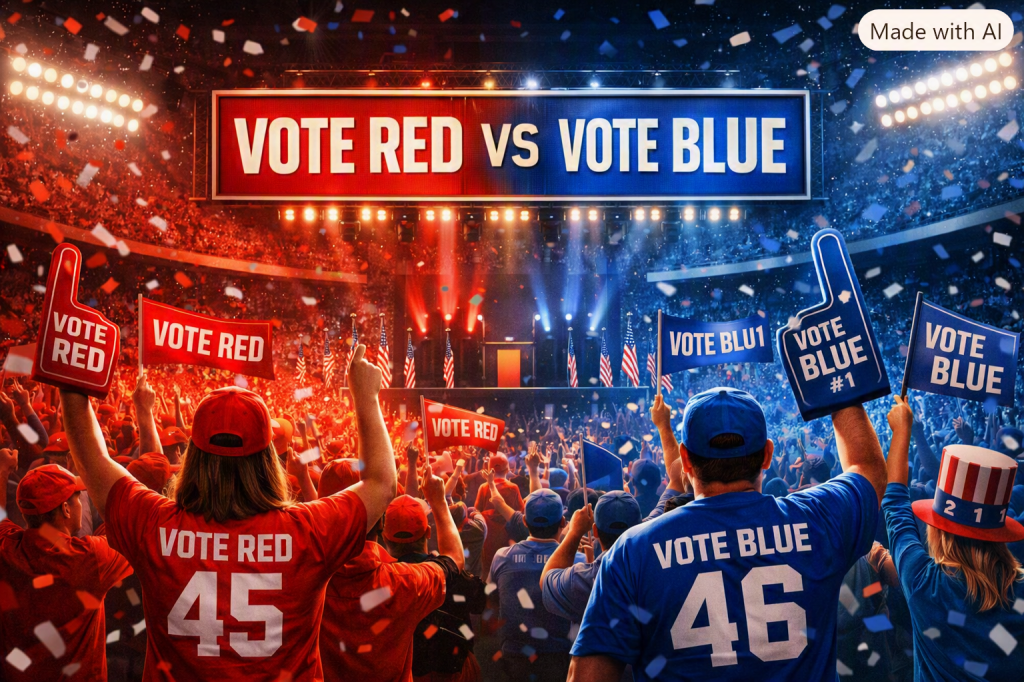
There is a brutal, inconvenient truth about American politics today: millions of voters are fiercely loyal to leaders who have not improved their lives — and may have made them worse. This isn’t about intelligence. It isn’t about education. It isn’t even about policy. It’s about something far more primal: tribal identity that overrides self‑interest.
Gas prices rise. Groceries cost more. Healthcare drains bank accounts. Wages stagnate. A tiny elite accumulates more wealth than entire states. And yet, vast numbers of Americans continue to support political figures whose promises evaporated the moment they were spoken.
Why?
Because in the United States, political loyalty has mutated into something closer to sports fandom than civic engagement.
A football fan doesn’t abandon her team when it loses. She doubles down. She buys the jersey. She defends the coach. She argues with strangers online. She knows the team is terrible — but it’s her team. Leaving feels like betrayal. Losing feels like loyalty.
American voters behave the same way.
Even when life becomes harder, many cling to leaders who speak their anger, validate their resentment, and insult the people they already dislike. They are not voting for policies. They are voting for emotional alignment. They are voting for identity protection. They are voting for the tribe.
And political operatives know it.
They know that if voters stay angry, they stay loyal.
They know that if voters stay divided, they stay predictable.
They know that if voters stay tribal, they stay controllable.
Meanwhile, the wealthiest sliver of the country — a group so small it could fit inside a football stadium — continues to shape policy, influence elections, and accumulate fortunes that no human being could ever spend. They benefit from a nation distracted by cultural battles and symbolic victories. They benefit from voters who treat politics like a rivalry instead of a responsibility.
Contrast this with northern Europe, where citizens vote like adults rather than fans. They choose leaders based on outcomes, not outrage. They prioritize collective well‑being over tribal identity. They demand policies that actually improve life — and they get them. Universal healthcare. Affordable education. Strong worker protections. Low poverty. High trust. High quality of life.
Not because they are smarter.
But because they refuse to confuse belonging with benefit.
America has not made that shift.
Not yet.
Until voters stop cheering for political teams that keep losing — and start voting for policies that actually serve their lives — the majority will continue to struggle while a tiny elite thrives.
The question is no longer whether politicians are failing the people.
The question is why the people keep rewarding them for it.
And the answer, uncomfortable as it is, may be this:
America doesn’t have political parties anymore.
It has fan clubs.
And fan clubs don’t demand victories — they demand loyalty.
