
When Crisis Becomes a Business Model

Every time global tension rattles the oil markets, the pattern repeats itself with unnerving precision. Ordinary Americans pay more at the pump, and a small circle of fossil‑fuel executives see their profits swell. It’s a cycle so familiar that it barely registers as news anymore — but the speed and scale of the most recent price spike should force us to look more closely at who benefits when the world is on fire.

After the U.S. strikes in Iran, gas prices rose sharply, as they almost always do when conflict touches an oil‑producing region. Economists have been explaining this dynamic for decades: instability raises risk, risk raises prices, and consumers absorb the cost. What’s different now is how openly some political figures frame these spikes as opportunities rather than burdens.

In a recent post, Donald Trump wrote that “we make a lot of money” when oil prices rise. He didn’t specify who “we” refers to, but the beneficiaries are not hard to identify. The people who profit most from volatility are the same executives who have spent years funding campaigns, lobbying for deregulation, and securing tax incentives that tilt the playing field in their favor.

And the markets responded exactly as expected. Analysts at outlets like the Financial Times noted that if elevated crude prices hold, major U.S. oil and gas companies could see tens of billions in additional revenue this year. Publicly traded firms signaled to investors that they were well positioned to capitalize on the moment. None of this requires speculation; it’s how commodity markets function.

Several of the companies now poised to benefit have long‑standing financial ties to Trump‑aligned political groups. Their CEOs have appeared on earnings calls describing how global instability strengthens their competitive position. That doesn’t prove intent behind any military decision — but it does reveal alignment. Policies that loosen regulations, expand tax incentives, or weaken oversight consistently reward the same donors who help keep certain politicians in power.

This is the architecture of influence in American politics:

  • Wealthy donors fund campaigns.
  • Those campaigns produce policies that increase donor profits.
  • Those profits then finance the next round of political influence.

Meanwhile, the public pays the bill — in higher fuel costs, higher transportation costs, and higher household expenses.

And the pattern isn’t confined to fossil fuels. In the tech sector, leaders are increasingly candid about the societal consequences of their own products. When a major AI executive acknowledges on national television that his technology could reshape the labor market in ways that disproportionately affect highly educated women — and then shrugs off the implications — it exposes the same concentration of power, the same absence of accountability, the same confidence that no one will stop them.

These are not isolated anecdotes. They are symptoms of a political economy where a handful of industries have the resources to shape policy outcomes in ways that serve their interests, even when those outcomes harm the broader public.

Taxing extreme wealth and enforcing meaningful checks on corporate power are not radical proposals. They are the basic tools of a functioning democracy — one in which public policy is shaped by the needs of the many rather than the profits of the few.

If we want a political system that works for ordinary people, we have to confront the cycle that rewards the same small group every time crisis hits. Until then, volatility will remain a business model, and the rest of us will keep paying for it.

When Power Rejects Accountability: What the Kent Resignation Tells Us About Trump’s Leadership Culture

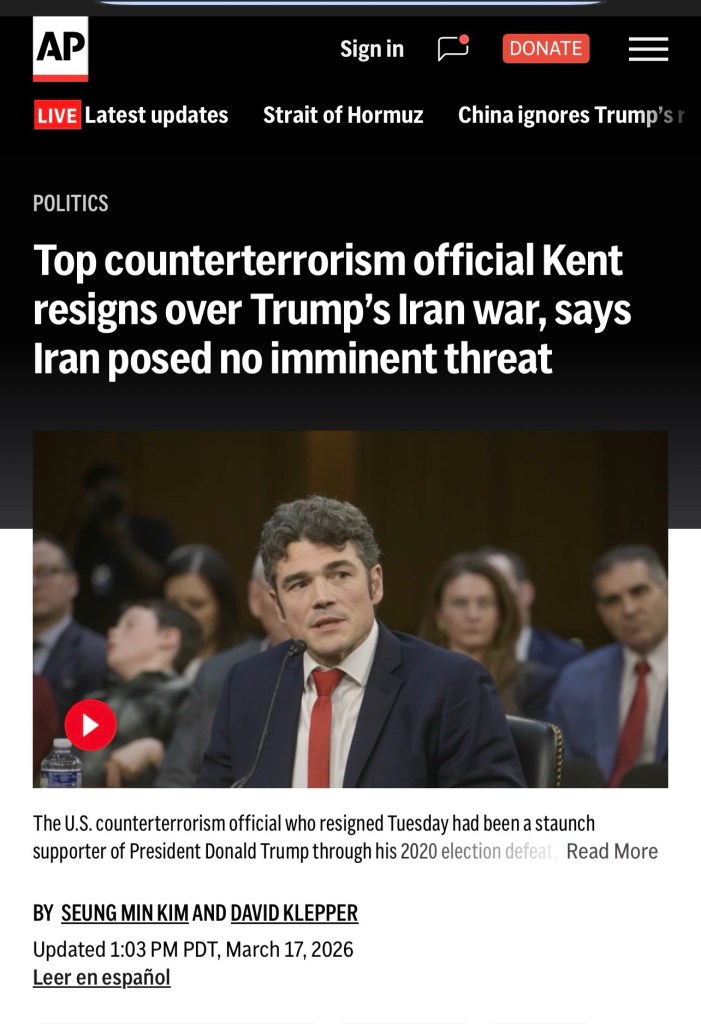
The resignation of National Counterterrorism Center Director Joe Kent should have opened a rare window for introspection inside the administration. Kent did not leave in silence. He left with a warning: that the march toward war with Iran lacked an imminent threat, lacked strategic coherence, and was propelled by pressures the public has not been allowed to see. These are the kinds of concerns a healthy administration would confront head-on.

Instead, the president dismissed Kent as “weak on security” and “not up to the job.” The critique was not answered; the critic was diminished. And in that exchange — documented plainly in the AP report — we see a leadership culture that treats dissent not as a resource but as a threat.

This is not an isolated moment. It is a governing pattern. Appointees are celebrated when they affirm the president’s position and maligned when they depart from it. The shift is instantaneous: competence becomes incompetence, loyalty becomes betrayal, and expertise becomes weakness. The individual changes; the script does not.

What makes the Kent episode especially revealing is the gravity of the issue at hand. War demands clarity, accountability, and the courage to face uncomfortable truths. Kent attempted to raise those truths. The administration responded with personal attack. The public is left with no clearer understanding of the policy — only a clearer understanding of the leadership style.

A government that cannot tolerate internal critique becomes brittle. It loses the ability to self-correct. It drifts toward decisions shaped not by deliberation but by deference. And when the stakes are measured in lives, that brittleness becomes dangerous.

The AP report does not editorialize. It simply records what was said. But the implications are unavoidable. If every departing official is recast as weak or disloyal, the public must ask whether the problem is always the appointee — or whether the deeper issue is a leadership culture that rejects accountability itself.

In moments of national consequence, the country needs leaders who can absorb critique without collapsing into grievance. Leaders who can distinguish disagreement from disloyalty. Leaders who understand that strength is not measured by the volume of one’s dismissals but by the capacity to engage the truth, even when it is inconvenient.

Joe Kent’s resignation offered an opportunity for that kind of leadership. The response made clear that opportunity was refused.

A School Was Bombed. The World Must Speak.

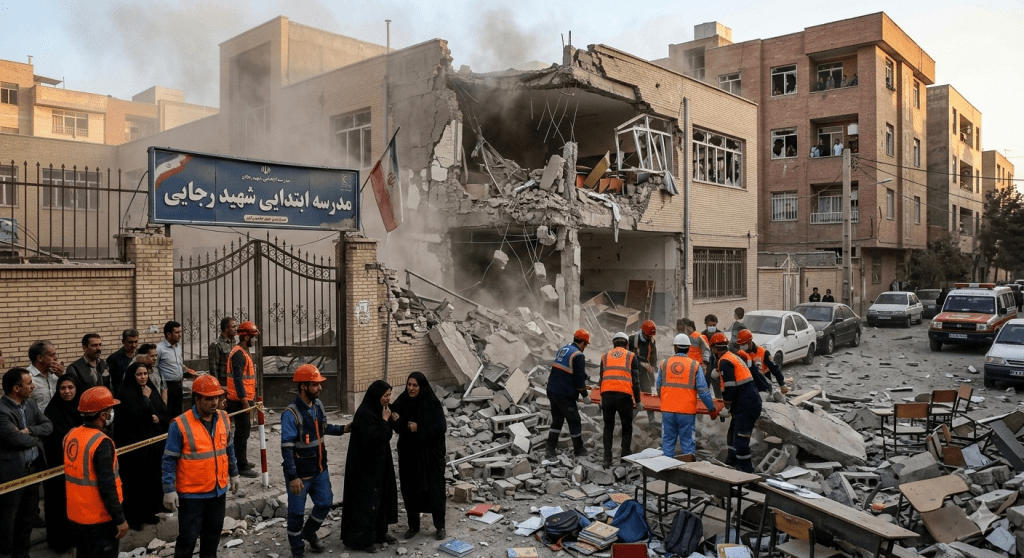
A school was bombed in Minab.

More than 150 children died.

That is not rumor — that is verified loss.

And when children die in their classrooms, the world does not need spin, or deflection, or leaders reaching for the nearest convenient enemy. The world needs truth. The world needs grief. The world needs accountability that does not wait for political permission.

A prophetic voice begins here:

No nation is righteous enough to excuse the killing of children.

No military is precise enough to call this “collateral.”

No leader is credible if they answer a mass grave with a shrug or a conspiracy.

The facts are still being investigated.

But the scale of harm is not in question.

And when the smallest coffins are lowered into the ground, the burden of truth rises — not falls.

So this must be said plainly:

• A school is not a battlefield.

• A child is not an acceptable loss.

• And any government involved — directly or indirectly — owes the world not a justification, but a confession.

Prophetic speech does not wait for the powerful to feel ready.

It speaks because the dead cannot.

Update:

The most authoritative, up‑to‑date figure comes from Al Jazeera’s live casualty tracker, which reports:

“168 children were killed in the Minab elementary school strike.”

This aligns with the higher end of earlier reports (115–168 total children), but the 168 figure is the latest confirmed and comes from Iran’s deputy health minister speaking directly to Al Jazeera.

A Clearer Look at the Iran Narrative

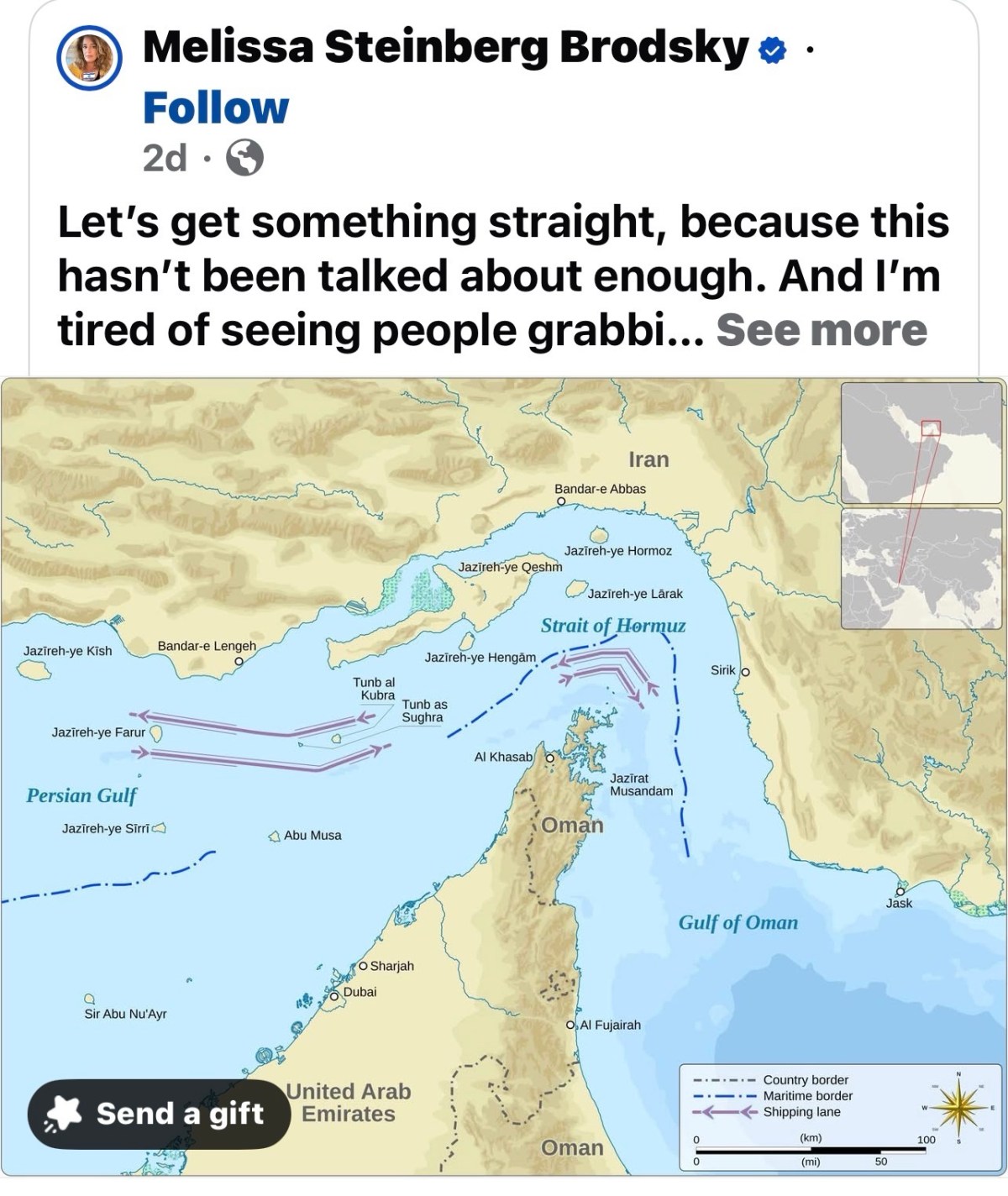
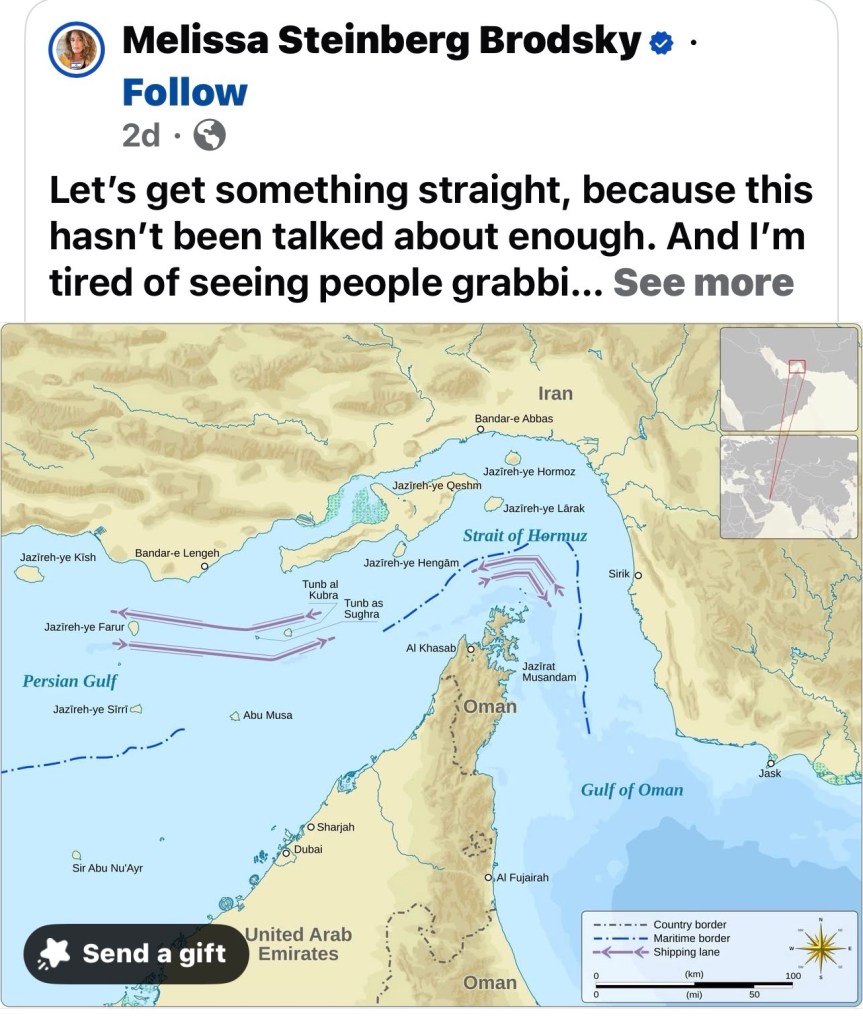
Public conversations about Iran often swing between oversimplification and outright conspiracy. It’s true that misinformation circulates quickly, but correcting it requires more than replacing one sweeping narrative with another. The argument I am responding to was written by Melissa Brodsky, a digital creator who publicly identifies as a “loud and proud Zionist” (see link at the bottom). That self‑description does not invalidate her position, but it does clarify the lens through which she interprets the current conflict. Her recent post, which frames the Iran escalation as unrelated to Israel and rooted solely in longstanding U.S. policy, reflects that perspective. Understanding the commitments from which she writes helps situate the narrative she presents.

It is accurate that every U.S. administration since 1979 has opposed a nuclear‑armed Iran. That position is consistent with long‑standing nonproliferation doctrine, not with any single president’s ideology. But to suggest that Israel’s security concerns are irrelevant to U.S. decision‑making is historically incomplete. For decades, American and Israeli intelligence, diplomacy, and military planning have been intertwined on the Iran question. Untangling them for the sake of rhetorical clarity does not make the picture more accurate.

The claim that Iran “dramatically accelerated” its nuclear program may be true, but it requires evidence, not assertion. Diplomatic agreements—including the 2015 nuclear deal—were designed precisely to slow enrichment and increase transparency. For a time, they did. If Iran’s program surged in recent years, that development cannot be separated from the collapse of those diplomatic frameworks, nor from the decisions that hastened that collapse.

China’s dependence on Iranian oil and the strategic importance of the Strait of Hormuz are not new revelations. They are well‑known features of global energy politics. Their inclusion in the argument does not necessarily illuminate the present moment; it simply restates the geopolitical landscape that has existed for decades.

The most consequential claim—that the United States acted because the threat was “imminent”—is the one that requires the greatest scrutiny. Diplomatic channels were active. Regional intermediaries were engaged. Negotiations, while fragile, had not collapsed on their own. The idea that military action became unavoidable only after fifty years of restraint overlooks the role of policy choices that disrupted talks and escalated tensions. Imminence is not a fact; it is a framing, and one that should be examined carefully.

The situation with Iran is complex, layered, and historically charged. Reducing it to a single cause—whether Israel, the United States, or China—does not help us understand it. What we need is not a new narrative to replace an old one, but a willingness to hold multiple truths at once: that diplomacy was working until it wasn’t, that policy decisions have consequences, that regional alliances matter, and that urgency should never be confused with inevitability.

In moments like this, clarity is not found in louder arguments, but in quieter, steadier ones.

https://www.facebook.com/share/p/1AvvGFetE9/?mibextid=wwXIfr

Outruns Truth: A Reflection on Leadership and the Markets

Author’s Note: I write this reflection not as an economist, but as someone who cares deeply about the integrity of public life. My concern is not partisan; it is human. In a time when narratives often outrun the truth, I believe we owe one another the courtesy of accuracy, humility, and respect. Leadership is strongest when it tells the truth plainly, without stretching it to fit a desired story. This piece is offered in that spirit.

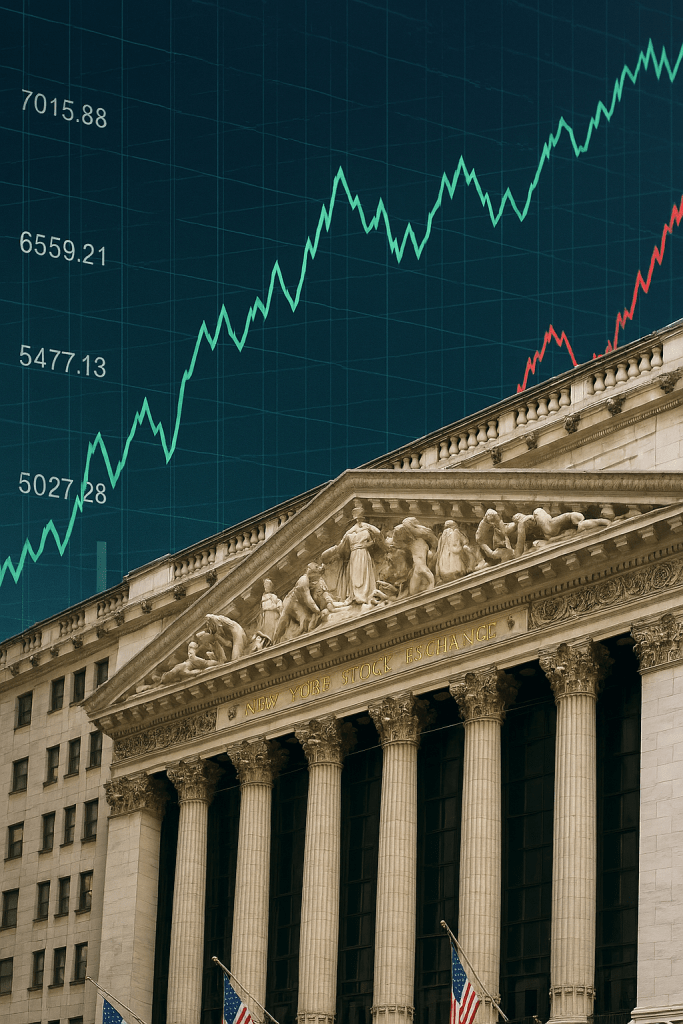
In his recent State of the Union Address, President Trump spoke with confidence about the strength of the stock market under his leadership. It was a bold claim, delivered with the certainty that often accompanies political speeches. But as I listened, something in me hesitated. Not out of cynicism, but out of a simple desire for truthfulness — the kind that does not stretch itself to fit a narrative.

The numbers tell a different story.

The market’s strongest gains — the remarkable climb of 2023, 2024, and the early part of 2025 — all happened before the current administration began. Those gains were already in motion long before January 2025. They were shaped by global recovery cycles, Federal Reserve policy, technological expansion, and the resilience of American companies. They were not the product of a single leader, and certainly not the product of a term that had barely begun.

Yet in the SONA, those years were gathered up and presented as evidence of presidential accomplishment.

This is where my concern lies. Not in the politics, but in the integrity of the claim.

Economists across the spectrum have long said that presidents do not control the stock market. They influence sentiment, yes. They can shape policy, yes. But the market responds to forces far larger and more complex than any one administration: global supply chains, interest rates, inflation cycles, technological innovation, geopolitical tensions, and the decisions of millions of investors acting independently.

To claim personal credit for a multi‑year rise that predates one’s term is, at best, an oversimplification. At worst, it is a quiet rewriting of the timeline — a way of gathering unearned accomplishments into one’s own narrative.

And I say this not as a partisan critique, but as a human concern.

Because leadership, at its best, is not about claiming what one has not done. It is about telling the truth even when the truth is less flattering. It is about acknowledging the work of others, the complexity of systems, and the limits of one’s own influence. It is about resisting the temptation to turn every good thing into a personal victory.

What troubles me is not the boast itself, but the pattern it represents — a pattern in which public claims drift away from public reality, and the distance between the two becomes normalized. When that happens, trust erodes. And when trust erodes, institutions weaken.

I am not asking for perfection. I am asking for honesty.

A leader does not need to own the stock market to lead well. A leader does not need to claim credit for what came before. A leader does not need to bend the timeline to appear successful.

What we need — what I long for — is a leadership that is simple, truthful, respectful, and grounded. A leadership that does not fear humility. A leadership that can say, “This rise began before me,” and still stand tall.

In a world already strained by misinformation and narrative‑shaping, truthfulness is not a luxury. It is a responsibility.

And it is one we should expect from anyone who asks to lead us.

When Admiration Becomes Blindness

By Ed Fernandez

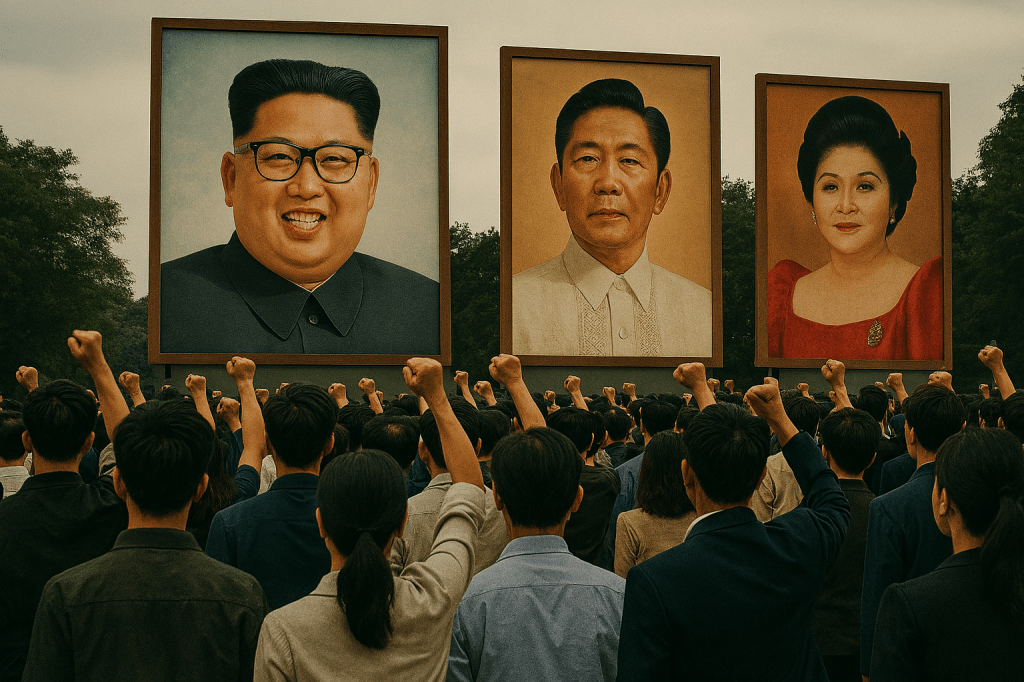
My wife and I recently watched a National Geographic documentary on North Korea’s dictator, and we found ourselves stunned by the way he is worshiped like a god. It made me wonder how political devotion can harden into something unshakeable — something that prevents people from seeing what is right in front of them.

I know what it means to admire a leader. When I was a boy in rural Mindanao, I was chosen to greet President Ferdinand Marcos Sr. as he stepped off a helicopter. To a child, that moment was dazzling. I became a fan — not only of him, but of Imelda Romualdez Marcos, the former beauty queen whose elegance captivated the nation.

But admiration has a way of maturing when reality intrudes. Under Martial Law, I saw the cruelty of soldiers at checkpoints between Norala and Cotabato City. I heard the stories of “salvage” victims — people killed for resisting the regime. I witnessed how power could be used not for service but for plunder. Those experiences forced me to re‑evaluate the man I once admired. I changed my mind because the truth demanded it.

And so I find myself grieving when I see friends who remain loyal to leaders whose actions have caused undeniable harm. Some of my friends continue to defend former President Rodrigo Duterte, even as evidence mounts about extrajudicial killings and the possibility that the drug war served interests far darker than public safety. Their devotion seems to override their capacity to evaluate the facts.

Why is it that some people can re‑examine their loyalties while others cannot?

I don’t believe in predestination. I believe people have the freedom to think, to choose, to change. But I also know that we are shaped by our fears, our loyalties, our communities, and the stories we tell ourselves about the leaders we admire. And I know I am not infallible — I do not understand everything.

Still, I return to this question:
What allows one person to step back and see clearly, while another clings to the image of a leader long after the truth has become impossible to ignore?

I don’t have a final answer. But I know this: the ability to re‑evaluate our heroes is not a sign of disloyalty. It is a sign of moral courage. And in times like ours, courage may be the only thing that keeps admiration from becoming blindness.

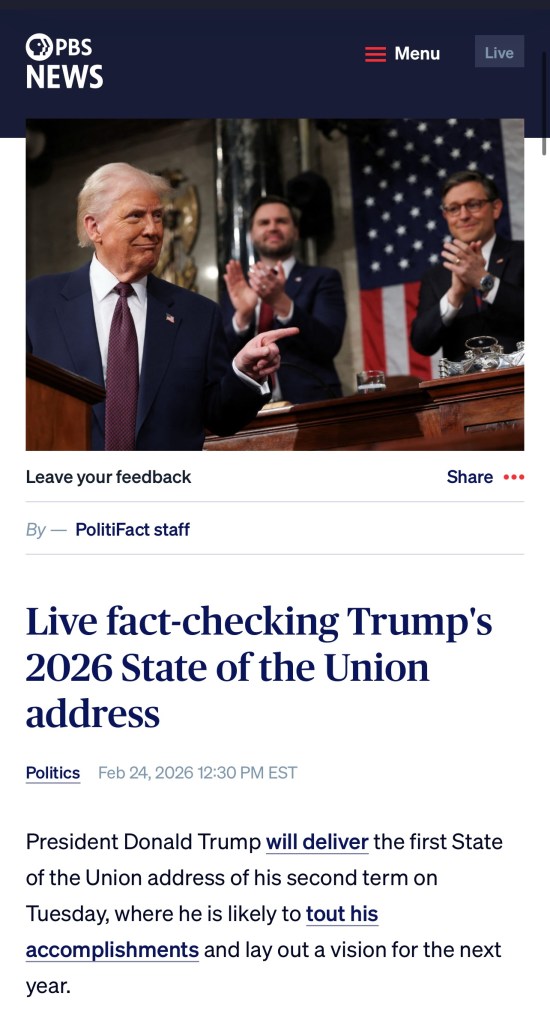
When a State of the Union Needs a Fact‑Checker in the Room

There’s a particular kind of irony that doesn’t make you laugh so much as exhale — that quick, knowing breath that says, Of course this is where we are now. That was my reaction reading PBS’s live fact‑checking of the 2026 State of the Union address.

The article itself is straightforward enough: a running, real‑time verification of the President’s claims as he delivers them. But the very existence of such a feature — and its necessity — says more about the state of the country than any line in the speech.

To be fair, fact‑checking the State of the Union isn’t new. Newsrooms have been doing it in some form since the early 2000s. But the feeling of it has changed. What used to be a next‑day analysis has become a parallel broadcast. What used to be a journalistic courtesy now feels like a civic safeguard. And that shift — from optional to essential — lands differently depending on who is speaking.

PBS didn’t treat their fact‑check as a novelty. It was presented as a public service, almost a requirement. Before the President even began, they reminded readers that only 19% of his campaign promises had been fulfilled, according to PolitiFact — a quiet signal that the evening would require context, correction, and careful listening. That’s the part that stays with me. Not the claims themselves, but the infrastructure now required to accompany them.

The State of the Union used to be a report to the nation. Now it arrives with a chaperone.

It’s tempting to laugh at the absurdity of it — the way the fact‑checkers sit just offstage, ready to annotate the moment. But beneath the humor is something heavier: a grief for what public discourse once aspired to be. The need for real‑time verification is not a sign of a healthy political culture. It’s a sign of erosion — of trust, of shared reality, of the assumption that words spoken from the highest office should at least gesture toward truth.

And yet, there is something quietly hopeful in the work PBS and others are doing. Their presence is steady, unflustered, almost pastoral in its own way. They don’t interrupt. They don’t editorialize. They simply place the facts beside the claims and let the contrast speak for itself. In a time when spectacle often overwhelms substance, that restraint is its own form of civic care.

A State of the Union that requires real‑time verification is not a sign of national strength. It’s a sign of how far we’ve drifted from the expectation that truth belongs at the center of public life. Until that expectation returns, the fact‑checkers will remain in the room — not as critics, but as guardians.


Link to PBS article:

https://www.pbs.org/newshour/politics/live-fact-checking-trumps-2026-state-of-the-union-address