
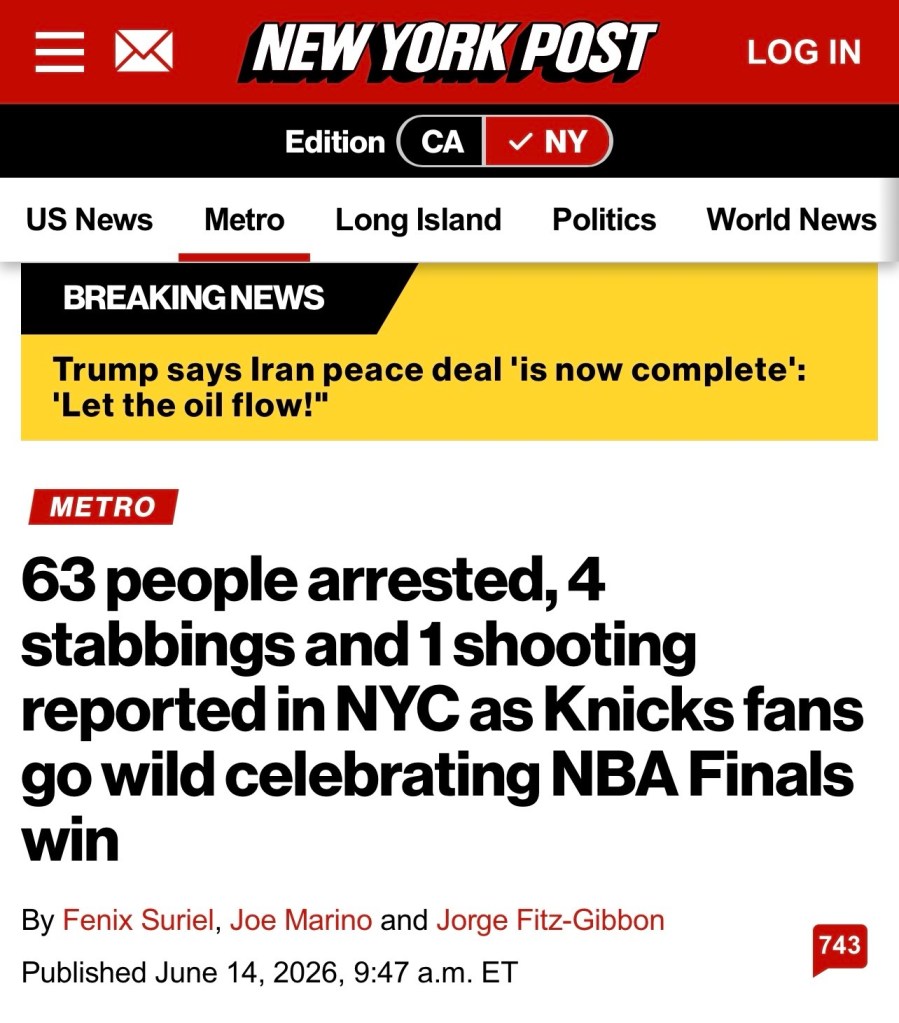
I have lived in the United States long enough to understand its history with contradictions, but some moments still leave me puzzled. The latest came after the New York Knicks won the NBA Finals — a moment of joy, relief, and civic pride. Yet the night ended with smashed windows, overturned barricades, and dozens of arrests. A celebration became a scene of chaos.
As an immigrant, I find myself asking a question I never had to ask back home:
Why does joy in America so often come with a bruise?
Where I grew up, a sports victory was a communal exhale. People laughed, shared food, teased each other, and went home with their dignity intact. The idea of celebrating by destroying property or fighting strangers would have been unthinkable — not because we were better people, but because joy was relational, not performative. You celebrated with your neighbors, not against the city.
In America, I’ve noticed something different. A small but loud minority seems to believe that celebration must be loud, unruly, even violent — as if joy is not complete until something breaks. It is not the whole country, not even most fans. But it is a pattern, and patterns deserve reflection.
Part of it is cultural. American sports fandom is not just entertainment; it is identity, tribe, and emotional outlet. A championship win feels like a personal triumph, and for some, that intensity spills over. Add alcohol, anonymity, and the adrenaline of a crowd, and the line between celebration and chaos dissolves quickly.
But there is something deeper at play. America is a nation that prizes individual freedom, sometimes to the point of forgetting that freedom without responsibility is simply permission to harm. Public order is not a shared value here in the way it is in many immigrant cultures. The threshold for “unacceptable behavior” is lower, and the consequences often feel abstract.
Still, I wonder if the real issue is emotional vocabulary. Many Americans know how to win loudly, but not how to celebrate gently. Joy becomes spectacle. Excitement becomes aggression. A moment meant for unity becomes an excuse for disorder.
And yet, I do not write this as a condemnation. I write it as someone who loves this country enough to hope for better. America is capable of extraordinary generosity, creativity, and communal spirit. I have seen it in hospitals, churches, neighborhoods, and classrooms. I have seen it in the quiet ways people care for strangers.
Which is why the violent celebrations feel so out of place — not because they reveal who Americans are, but because they obscure who Americans can be.
A championship win should be a moment of shared delight, not shared damage. A city should wake up proud, not sweeping broken glass. And joy — real joy — should never need a police barricade to contain it.
Perhaps someday, America will learn to celebrate victories the way it dreams: boldly, freely, and without leaving scars behind.